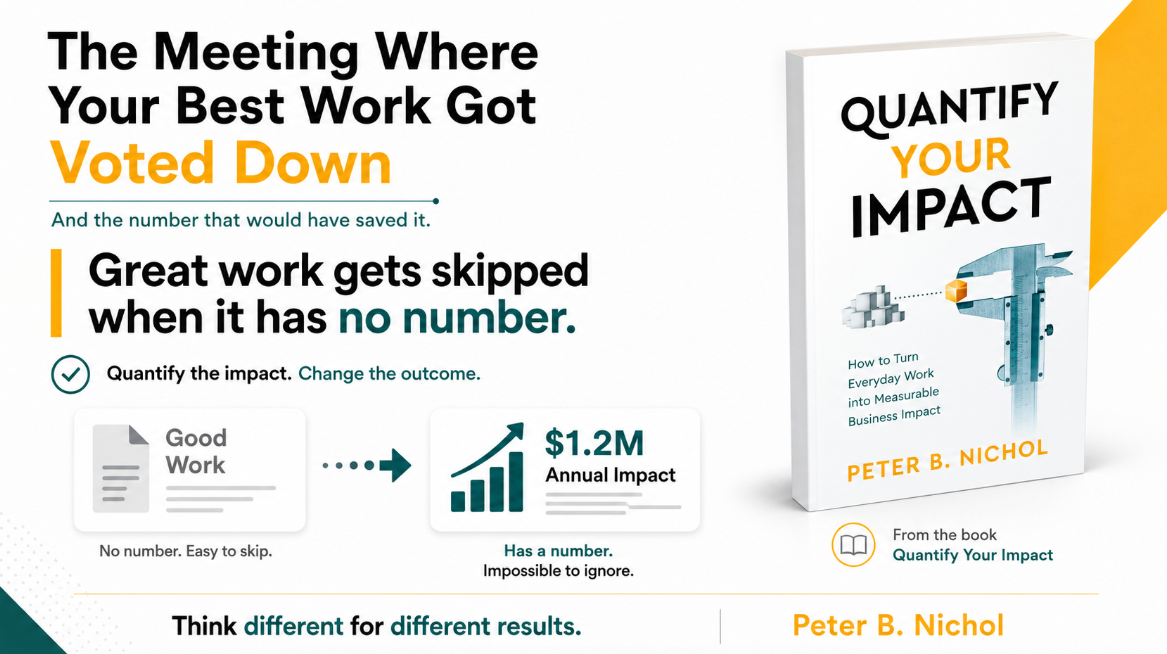
There is a particular kind of quiet that happens in a budget review. Not the good quiet. The kind where you finish presenting the initiative you are proudest of, the one your team spent two quarters building, and the room just moves on. No hostility. No debate. Someone nods, says “let’s revisit next cycle,” and the next line item comes up. Your work was not rejected. It was skipped.
I have watched that happen to genuinely excellent work more times than I can count. And after twenty years of sitting on both sides of that table, as an engineer, a CIO, and now leading data and analytics portfolios, I have stopped believing the problem is the work.
Part 1: The Work Was Never on Trial
Here is the uncomfortable truth. In the room where funding gets decided, nobody is evaluating your architecture. Nobody is admiring your integration design or your data model or the elegance of how the pipeline handles edge cases. Those things are real, and they matter, but they are not what is being weighed.
What is being weighed is a list of numbers. Every initiative that survives that meeting arrives as a number: a cost avoided, a cycle time reduced, a revenue stream protected, a risk priced. The ones that arrive as descriptions, however impressive, get filed under “sounds valuable, can’t rank it.” And you cannot fund what you cannot rank.
This is the trap that catches strong technical leaders specifically. The better your work is, the more you assume it speaks for itself. It does not. In a budget review, work does not speak. Numbers speak. Your work sat there, mute, next to six other line items that had learned the language.
Part 2: What Actually Happened in That Room
Play the scene back and watch the mechanics. The finance lead is not being difficult. They are being forced to sort. They have a fixed pool of money and a stack of requests that exceeds it, and their entire job in that hour is to produce a ranked order. Anything that cannot be placed in that order gets deferred, not because it lacks value, but because it lacks a coordinate.
Your competitor for that funding, the initiative that got approved while yours got skipped, was very likely not better work. It was better positioned. Someone attached a defensible number to it early, socialized that number before the meeting, and walked in with a figure the finance lead could drop straight into the ranking. That is the whole game. The number does not have to be big. It has to exist, and it has to hold up when someone pushes on it.
This is why I keep saying the leader who keeps their funding is rarely the one with the strongest portfolio. It is the one who puts a number on the table before anyone asks for it.
Part 3: The Number You Should Have Had
So what was the number that would have saved your initiative? Not a made-up one. Not a hopeful projection you cannot defend. A quantified, traceable figure that connects the technical work you did to a business outcome someone in that room already cares about.
Most technical leaders do not have that number for a simple reason: nobody ever taught them how to build one. Quantifying the value of data, analytics, and integration work is a specific skill, and it is not intuitive. It requires a repeatable method for turning “we improved the pipeline” into “we reduced X by Y, worth Z annually.” That translation is learnable, and once you have the method, you never walk into a budget review naked again.
That method is exactly what I wrote Quantify Your Impact to teach. It is the first book in the BRM Accelerator Series, and it exists because I got tired of watching good people lose funding for good work simply because they never learned to price it. If your best work has ever been quietly skipped in a room full of numbers, this is the book that fixes the cause, not the symptom.
Get it here: Quantify Your Impact on Amazon ($24.95, paperback).
Think different for different results.