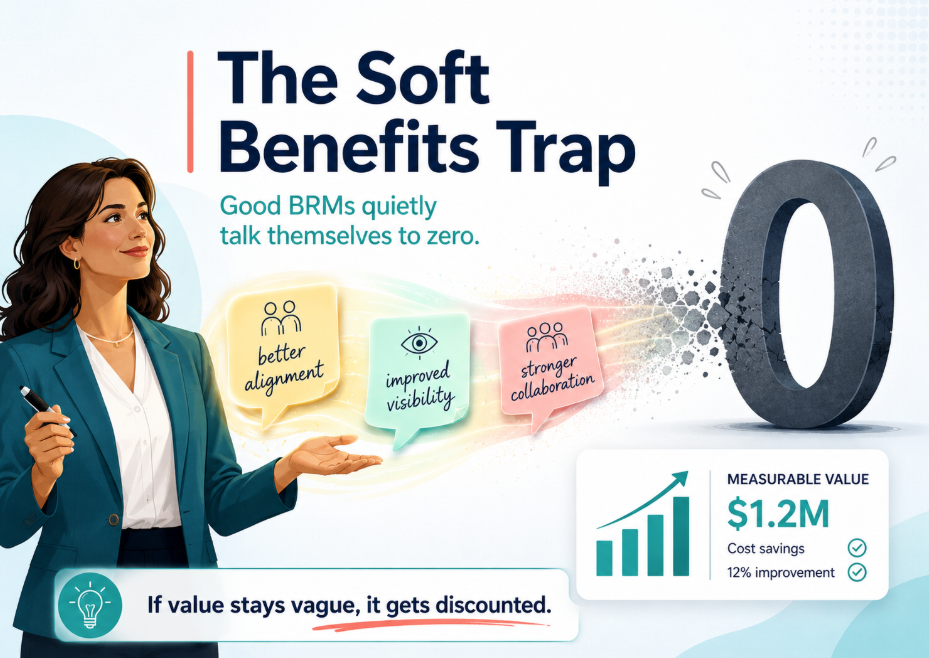
Listen to how technical and relationship leaders describe their own work in funding conversations, and you will hear a specific phrase over and over. “The hard savings are around forty thousand, and then there are some soft benefits on top of that.” It sounds humble. It sounds honest. It sounds like someone being careful not to overclaim.
It is also the exact moment the value evaporates.
I have spent twenty years watching capable people undercut their own initiatives, and the “soft benefits” phrase is the most common self-inflicted wound I see. The person saying it thinks they are being credible. What they are actually doing is standing in front of the finance lead and handing them permission to round half the value down to nothing.
Part 1: What “Soft” Actually Signals
Here is what you think “soft benefit” means: a real benefit that is harder to measure precisely.
Here is what the person holding the budget hears: a benefit the presenter could not be bothered to quantify, and therefore one I am free to discount to zero.
Those are not the same message, but you only control the first one. The second one is what determines whether your number survives. When you label something “soft,” you are not adding a caveat. You are making a ranking decision on your own initiative, and you are ranking the benefit at zero. Finance simply accepts the ranking you volunteered.
The tragedy is that most “soft” benefits are not soft at all. Reduced rework, faster decision cycles, lower analyst burnout, fewer escalations, better data trust across a business unit. Every one of those has a defensible dollar figure sitting underneath it. It is not there because someone stopped digging one layer too early and reached for the word “soft” as a shortcut.
Part 2: The Anatomy of a Benefit That Got Away
Take “this saves the team a lot of manual effort.” That is the sentence that dies as a soft benefit. Now watch it get resurrected.
How many people? Say four analysts. How many hours per week does the manual work consume? Say six each. That is twenty-four hours a week, roughly twelve hundred hours a year. What is the loaded hourly cost of an analyst at your organization? Call it eighty dollars. You are now looking at just under one hundred thousand dollars in annual capacity, and not one number in that chain was invented. Every figure is one your organization already knows or can produce in an afternoon.
That is the difference between a soft benefit and a hard one. It is not the nature of the benefit. It is whether you did the arithmetic. “Soft” is almost never a property of the value. It is a description of how far you stopped short of quantifying it.
And here is the part that should sting a little: the analyst-hours example is the easy one. The genuinely valuable benefits, the strategic ones, are the ones people abandon fastest because the chain looks longer. So the most important value in your portfolio is precisely the value most likely to get waved away as “soft.”
Part 3: Stop Discounting Your Own Work
The fix is not to overclaim. Overclaiming gets you caught, and getting caught once costs you credibility for years. The fix is to build the traceable chain from the technical work to the dollar figure, so that when you say a number, you can defend every link of it, and you never have to reach for “soft” as a hedge.
That discipline, turning vague benefit language into quantified, defensible figures without inflating anything, is a learnable method. It is the core of what I wrote Quantify Your Impact to teach. The book exists because I watched too many strong BRMs and product owners talk themselves down to zero in rooms where their work deserved a real number. Every “soft benefit” you have ever mentioned had a figure underneath it. This book is how you find it.
Get it here: Quantify Your Impact on Amazon ($24.95, paperback).
Think different for different results.