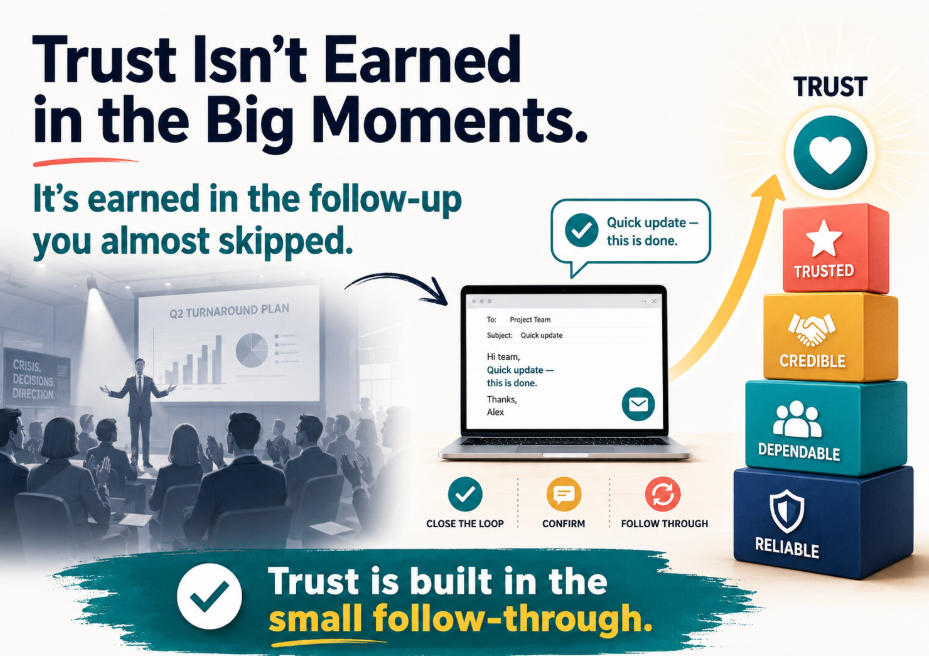
Ask most people how they earned a stakeholder’s trust and they will tell you about a moment. The crisis they handled. The impossible deadline they hit. The executive presentation that landed. There is always a story, and the story always has a hero beat in it.
I used to believe that too. Twenty years in, working across engineering, the CIO seat, and now leading data and analytics portfolios, I have come to think it is almost entirely wrong. The big moments do not build trust. They spend it. And what you get to spend in the crisis was quietly deposited long before, in a hundred moments so small you barely remember them.
Part 1: The Deposit Nobody Watched
Think about the last person you genuinely trusted at work. Not liked. Trusted, in the specific sense that you would hand them something important and stop worrying about it. Now try to name the single moment that trust came from. You cannot, and that is the point. It did not come from a moment. It accumulated.
It came from the email they said they would send by Thursday, and it arrived Wednesday. The number they promised to double-check, and they actually did, and they came back and told you it was fine before you had to ask. The meeting they could have let drift, and instead they closed the loop in two lines so you knew exactly where things stood.
None of those were heroic. None of them would make it into a performance review. And that is precisely why they built trust: because nobody was watching, which means the person did them for the work and not for the credit. Trust is not earned in front of an audience. It is earned in the follow-through that has no audience at all.
Part 2: Why the Follow-Up Is the One You Skip
Here is the mechanism that quietly erodes relationships. The follow-up is always the lowest-status task on your list. It is the two-line email confirming what you already discussed. It is the small loop that feels closed enough. It is the update nobody explicitly asked for. So under pressure, it is the first thing to go. You tell yourself they know it is handled. You tell yourself you will circle back. You almost skip it, and often you do.
But from the other side of the relationship, that skipped follow-up is not invisible. It is the exact spot where a small doubt takes root. Not a dramatic one. Just a quiet “I am not sure where that landed” that makes the stakeholder check in, or hedge, or keep a task on their own list that should have left it. Every skipped loop transfers a little anxiety back to them. And a stakeholder who has to carry anxiety about your reliability will never hand you the strategic work. They cannot afford to.
This is the part people miss when they chase the big moment. You do not get the crisis to be a hero in unless someone trusted you enough to put you near the crisis in the first place. And that trust was built in the follow-ups, long before the stakes were high.
Part 3: Mindset Over Mechanics
None of this is a technique you bolt on. You cannot fake consistent follow-through, because the whole signal is that you did it when nobody made you. It comes from a different place: a mindset about what the relationship is for and who you intend to be inside it. Get the mindset right and the small reliable behaviors follow on their own. Try to reverse-engineer the behaviors without the mindset and stakeholders feel the performance immediately.
That is the argument at the center of Earn Strategic Trust, the second book in the BRM Accelerator Series. It is not a book of relationship tactics. It is a book about the mindset that produces trust as a byproduct, so that when the big moment finally comes, you already have the standing to meet it. If your influence has ever plateaued despite doing good work, the gap is almost always here.
Get it here: Earn Strategic Trust on Amazon ($24.95, paperback).
Think different for different results.