Every IT, digital, and product leader I talk to is running the same gauntlet right now. AI pilots that need a business case. Process redesigns that need a payback. Platform migrations that need a defensible ROI. Automation programs that have to land, and then be measured.
The work is real. The outcomes are real. But somewhere between the team executing and the executives funding, value evaporates. The initiative ships, the demo impresses, and six months later nobody can articulate what it was worth in a budget review.
I’ve watched that pattern repeat for twenty years, as an engineer, a CIO, and now leading data, analytics, and integration portfolios. And the leader who keeps their funding is rarely the one with the strongest portfolio. It’s the one who puts a number on the table.
For a long time I thought this was a communication problem. It isn’t.
The Diagnosis Most Leaders Get Backwards
It’s a quantification, trust, and execution problem — in that order. You can’t earn strategic trust around value you’ve never quantified. And you can’t execute against a strategic agenda you were never trusted to shape. Most leaders attack this backwards: they push for a seat at the table first, then scramble for numbers when the funding question lands. The sequence is the whole game.
Once I understood that, the fix stopped being a tactic and became a system — one I’ve been building, testing, and refining across real portfolios for years, and eventually formalized as the Quantified Impact Framework™. The hardest part wasn’t inventing it. It was realizing that no single book, course, or certification taught the three pieces together. So I wrote them.
Three Problems, Three Books
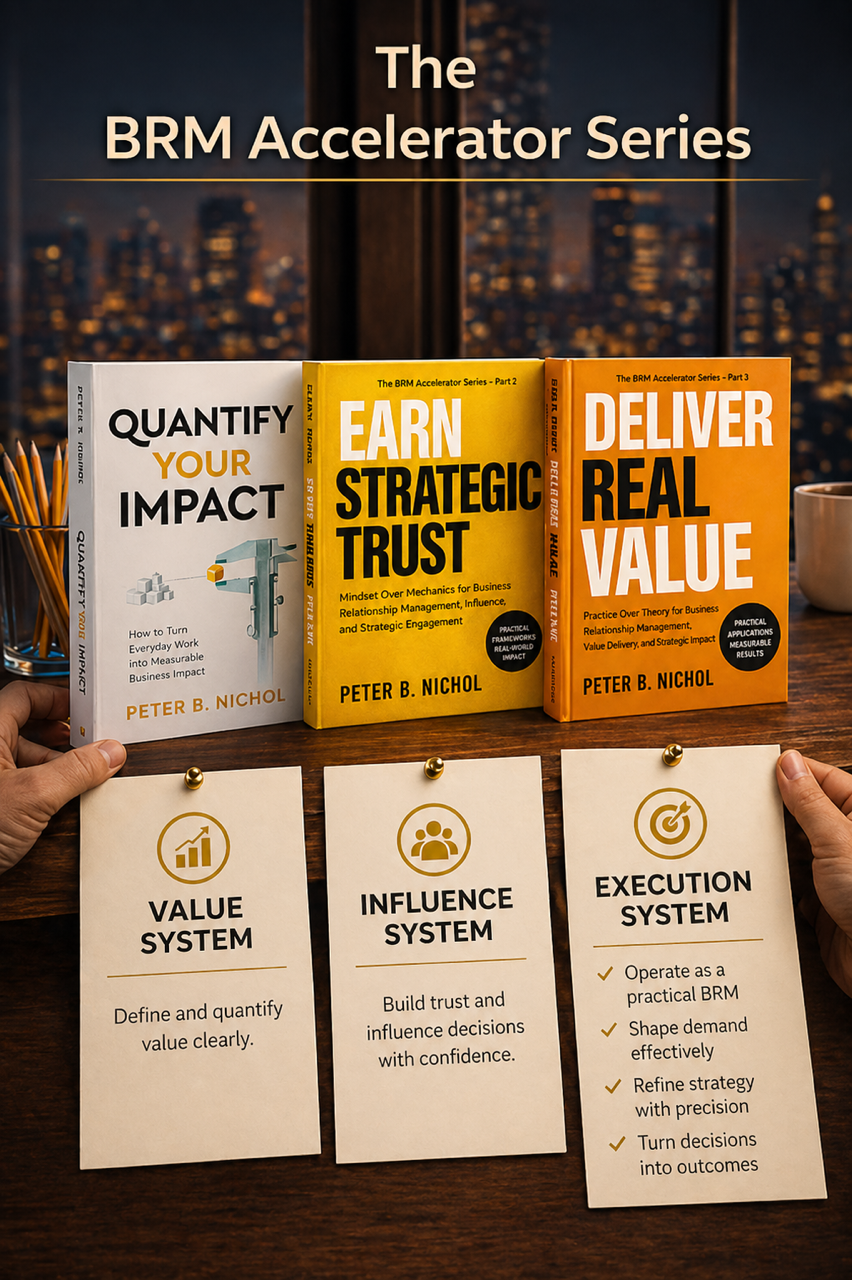
Problem one: your work is invisible at funding time. Quantify Your Impact solves this. It’s the framework book — including the exact field-by-field structure I use to turn a routine initiative into a number an executive can defend without me in the room. Hours avoided, dollars unlocked, risk retired, time recovered. Start here; everything else in the series assumes this language.
Problem two: you have numbers but no seat. Earn Strategic Trust solves this. It’s a 26-week development program covering what actually earns influence at the strategic table — stakeholder dynamics, value discovery, portfolio shaping — and why the “trusted advisor” posture most BRMs are taught quietly undermines all three.
Problem three: you have the seat but can’t convert it. Deliver Real Value solves this. A second 26-week program — the operator’s companion — that turns the theory into the weekly playbook: shaping demand, refining strategy, turning decisions into outcomes you can point to a year later.
Quantify gives you the language. Earn gives you the theory. Deliver gives you the practice. Together they’re a 52-week development arc — one read for the leader, a program for the team.
Where to Start
If any of the three problems above sounds like your Tuesday, the matching book is the entry point. If all three do — and for most IT, data, and product leaders I talk to, all three do — the series is built to be read in order. All three are on Amazon in paperback ($24.95 each):
- Quantify Your Impact — make value visible
- Earn Strategic Trust — earn the seat
- Deliver Real Value — deliver the outcomes
One more thing, for readers watching AI reshape their role in real time: The Operator Shift, a field supplement to Earn Strategic Trust, tackles AI compression head-on, including an updated maturity ladder that replaces the 2015 BRM Institute model and shows how to position yourself to leverage AI rather than be replaced by it.
The work your team does is real. Make sure the room knows what it’s worth.