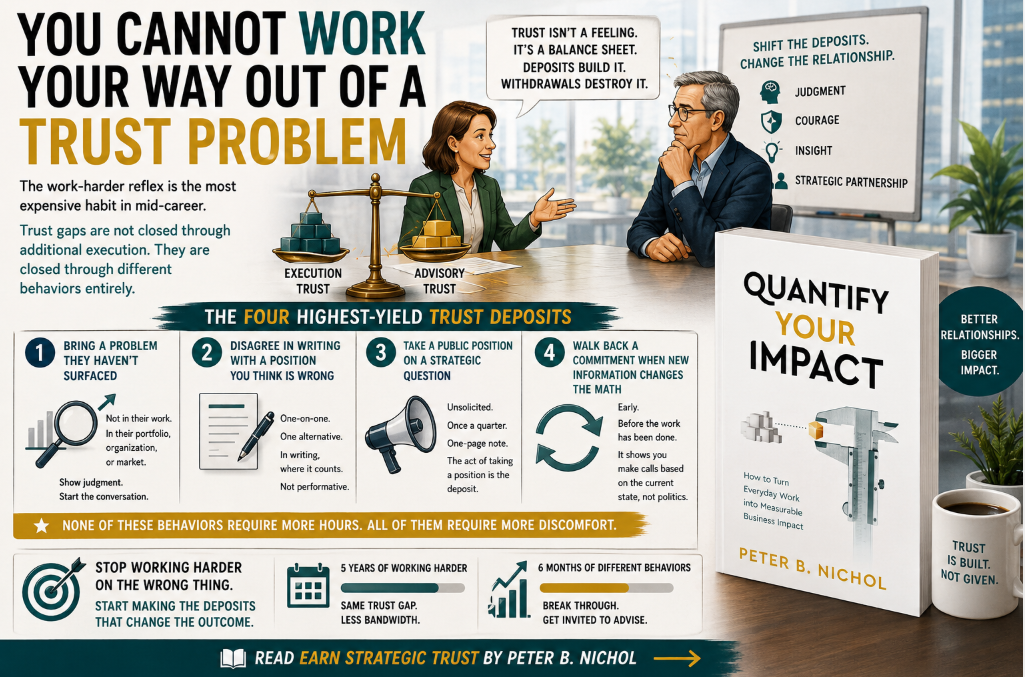
The work-harder reflex is the most expensive habit in mid-career. Trust gaps are not closed through additional execution. They are closed through different behaviors entirely.
If your sponsor relationship feels stuck, the worst thing you can do is work harder. Volume is not the asset the relationship is missing. Volume is what got you the relationship in the first place. Doubling down on it deepens the ceiling you are trying to break through.
This is the single most common pattern I have seen across mid-career BRMs and IT product owners. The relationship was built on delivery. The relationship has plateaued. The instinct is to deliver more. The result is a sponsor who trusts you to execute and a sponsor who does not, three years later, trust you to advise.
The trust gap between execution and advice is not crossed through additional execution. The two trust types are built from different deposits. You can be the most reliable executor in the building and your sponsor will still not bring you into the room where the strategy is being argued. Reliability builds execution trust. Reliability does not build advisory trust.
What builds advisory trust is a small set of behaviors that have nothing to do with capacity. They have to do with judgment, and the willingness to put your judgment on record before the outcome is known.
You bring your sponsor a problem they had not surfaced. Not a problem inside the work they assigned you. A problem in their portfolio, their organization, or their market that they should be acting on. This puts your judgment in front of them on a topic where they could have spotted it themselves and didn’t.
You disagree, in writing, with a position you think is wrong. In a one-on-one. With one alternative proposed. Not in a group meeting where the disagreement is performed. Not in a hallway aside where the disagreement is deniable. In writing, where it counts.
You take a public position on a strategic question, unsolicited. Once a quarter. A one-page note. Your sponsor’s peers can see what you think before they ask. The act of taking a position is the deposit. The accuracy of the position matters less than the existence of the position.
You walk back a commitment when new information changes the math. Early. Before the work has been done. The walk-back is not a failure. It is the trust artifact that shows your sponsor you make calls based on the current state, not the politically convenient one.
None of these behaviors require more hours. All of them require more discomfort.
This is what I now call the trust balance sheet model. Trust is not a feeling. It is an asset with deposits and withdrawals, a running balance, and compounding behavior over time. The behaviors above are the highest-yield deposits available. They are also the ones most BRMs skip, because the work-harder reflex is louder and more familiar.
I have watched practitioners spend five years working harder on a trust gap and end the five years with the same trust gap and significantly less personal bandwidth. I have watched practitioners spend six months practicing the four behaviors and break through to advisory conversations they had not been invited to in a decade.
The difference is not effort. The difference is the type of effort.
Earn Strategic Trust is the book for the second pattern. It lays out the trust balance sheet in detail. The deposits, the withdrawals, the compounding mechanics. The specific behaviors at each stage of a sponsor relationship. The recovery moves for trust that has already been damaged.
If you have been working harder on a relationship that is not moving, the book is for you. The work-harder reflex is the most expensive habit in this part of the career. Replacing it is the move.→ Read Earn Strategic Trust