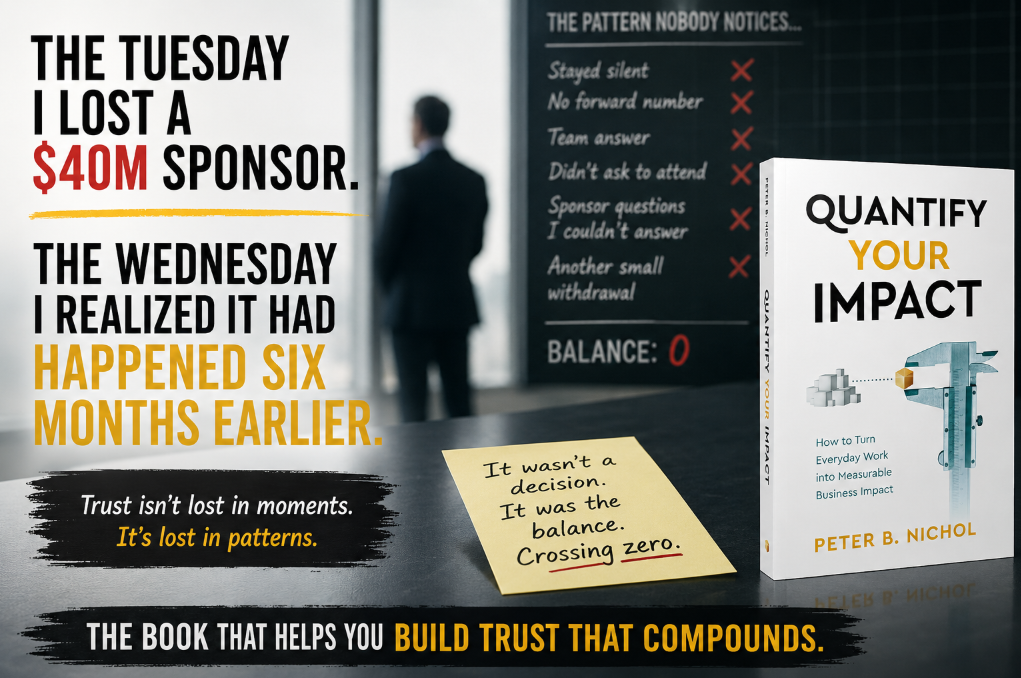
Trust at the executive level is not lost in moments. It is lost in patterns of small moments, none of which feel significant in isolation. The day you notice the loss is the day the cumulative balance crosses a threshold.
I remember the meeting where I lost a sponsor. It was a Tuesday. The conversation was civil. The decision was framed as a portfolio realignment. I walked out understanding that the scope I had been running was being moved to someone else, and the strategic conversations I had been participating in were going to continue without me.
I spent the rest of the week reviewing what had happened. I looked at my recent performance, my recent deliveries, my recent communication cadence. None of it was bad. By any objective measure, the quarter had been a strong one. The decision did not fit the data.
On Wednesday, I realized the decision was not made on Tuesday. The decision was made six months earlier, in a series of small moments I had not registered as moments. The Tuesday meeting was the announcement, not the event.
The actual event was a sequence. There was a steering committee where I had executed a sponsor decision cleanly even though I disagreed with it, and had said nothing in the one-on-one beforehand. There was a quarterly review where I had presented numbers without committing to a forward number my sponsor could carry to their boss. There was a conversation where my sponsor had asked me what I would do, and I had answered with what the team would do, a different question. There were three or four meetings I had been copied on but had not asked to attend, where my sponsor had been asked questions about my portfolio they could not fully answer.
None of these were dramatic. None of them produced a confrontation. All of them were small withdrawals from an account I had not been tracking, and the account had been quietly running down for two quarters before the balance reached zero.
This is the most underappreciated property of trust at the executive level. It does not get lost in moments. It gets lost in patterns of small moments, none of which feel significant in isolation. The day you notice the loss is the day the cumulative balance crosses a threshold. The withdrawals started months before.
The corollary is the part that took me longer to absorb. Trust is also not built in moments. It is built in the same pattern of small interactions, accumulating in the opposite direction. The dramatic act of trust-building, the heroic save, the brilliant analysis, has far less impact than I had assumed. What had impact was whether I showed up the same way for the unimportant interactions as I did for the important ones.
This is the trust balance sheet model. Two columns, a running total, and compounding behavior over time. Most BRMs are running the books on their relationships without realizing it. The books are accurate. The reporting is just delayed.
After the Tuesday meeting, I rebuilt how I track these accounts. I now keep a private journal of the small withdrawals I notice in my own behavior. The meetings I skipped, the disagreements I deferred, the sponsor questions I answered with team answers, the unsolicited points of view I did not write. Each entry is a withdrawal I caught in time. Most of them are recoverable. The ones I miss are the ones that accumulate.
I have not lost a sponsor relationship the same way since. The relationships have varied. The reading mechanism has not.
Earn Strategic Trust is the book that lays out the balance sheet in full. The deposits, the withdrawals, the compounding mechanics, and the audit process for catching withdrawals before they accumulate to the threshold. The book is, in part, a long version of the Wednesday after my Tuesday meeting.
If you have a sponsor relationship that has plateaued and you cannot point to a specific event that caused it, the book is for you. The event has no clean signature. The pattern does.