
Large language models are running the mobile phone’s sixteen-year innovation curve in eighteen months. The phone can tell you how this goes, and the ending is good news.
Same shape, shorter clock
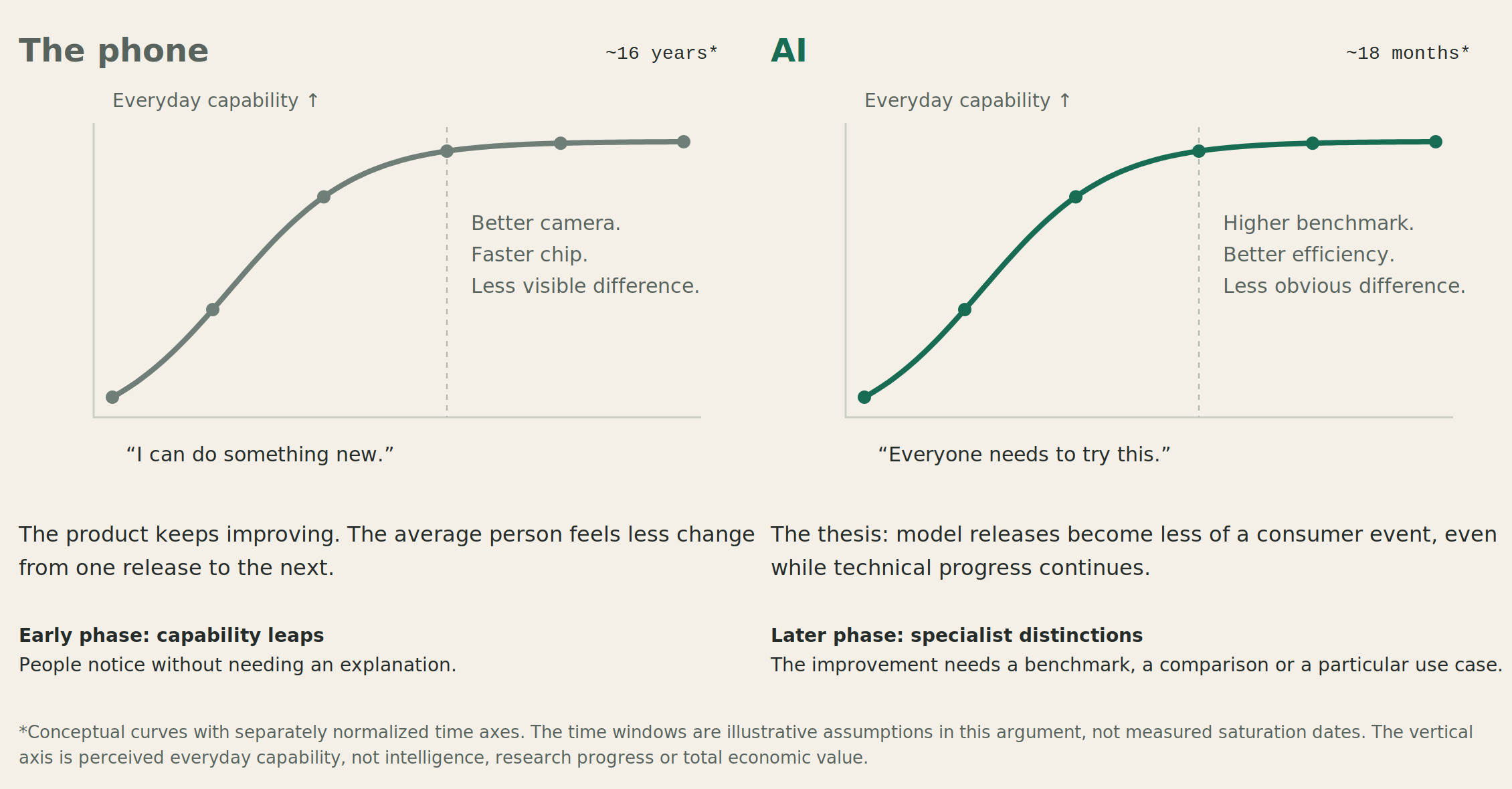
Picture the phone you carried in 1996 next to the one in your pocket. Between them sits a sixteen-year stretch in which each new capability changed what a normal person could do: text messaging in 1992, email on a BlackBerry, a camera you always had with you, the iPhone in 2007, the App Store in 2008. Each of those was a leap you could feel. Then, around 2008, the curve bent. Phones kept improving, but the improvements moved to the spec sheet. A better sensor. A faster chip. A new kind of glass. Real engineering, invisible to almost everyone who buys the thing.
Large language models are tracing the same curve on a shorter clock. From ChatGPT in November 2022 to the GPT-4o and Claude 3 generation in the spring of 2024, the public felt as many leaps as phones delivered in sixteen years. Eighteen months instead of sixteen years, which works out to roughly ten times faster. Since then the pattern has held. Models keep getting better, benchmarks keep moving, and a shrinking share of people can say what changed in the last release without looking it up.
That compression is why keeping up feels impossible. You are following the spec-sheet phase of a technology with the attention you learned to give the leap phase, and nobody told you the phase changed.
Version numbers are the new tailfins
In the 1920s, General Motors under Alfred Sloan began changing its cars every year on purpose. The engineering underneath moved slowly and the styling moved fast, so that last year’s car would look old in the driveway. Harley Earl, GM’s design chief, called it dynamic obsolescence. It peaked with the 1959 Cadillac, whose tailfins rose higher than any before or since, on a chassis that was a close cousin of the previous one.
Model version numbers do something similar to your nervous system. A new number implies a new category of machine. Most of the time it is a better sensor: more room for the document you hand it, fewer mistakes on a class of tasks, a lower price per token. Those are real gains. If you build software on these models, track them the way a photographer tracks camera bodies. If you use them to write, analyze and think, the honest summary of the last two years is that the tool got steadily better at what it already did.
None of this means progress has stopped, or that a decisive jump can never come again. Phones got one in 2007 after years of incremental releases. A release calendar is a marketing instrument as well as an engineering one, and it was never a measure of how far behind you are.
The part that transfers
The safety bicycle of 1885 settled the shape of a bike: two equal wheels, a diamond frame, a chain to the rear wheel. Everything since has been components. Gears, brakes, materials, electronics. Nobody relearns to ride when a new derailleur ships, because the skill lives in the rider rather than the parts list.
Working with a language model is that kind of skill, and it transfers across models better than most people expect. Saying what you want in plain words. Handing over the document instead of describing it. Asking for the reasoning before the answer. Checking the output against something you trust. Keeping a short file of prompts and procedures that work for your job. Each of those survives a model upgrade untouched, and most survive a switch to another vendor.
This is also where the value is moving. After 2008 the money in phones was made in apps, accounts and habits built on top of the hardware, not in the hardware race. The same shift is under way in AI. Everyone has access to a good model, so the durable advantage is how much of your work you have taught it to do and how much of that setup you own. The switching cost that matters is your accumulated context, not the model behind it.
Fear not: the boring part is the good part
The driverless elevator was invented around 1900. Riders stepped in, looked for the operator, and stepped back out. They kept doing that for decades. In 1945 New York’s elevator operators went on strike, the city stalled, and building owners demanded a change. The industry’s answer was not a faster elevator. It was a calm recorded voice, a big red stop button and a telephone. Within a generation nobody thought about elevators at all. They have kept improving ever since; many now pick your car before you reach the doors. Nobody keeps up with elevators. People ride them, and the ride keeps getting better.
That is where every useful technology ends up: still advancing, no longer demanding your attention. Phones arrived there around 2008. Language models are arriving there now, on a clock roughly ten times faster, and the loud stretch of the curve, the part that had you reading every announcement, is behind us. What remains is the long stretch where the tool gets better without asking you to notice.
The phone and AI innovation curve
That is great.
That is great, and it is worth saying why. The part of the curve that matters to an everyday user has flattened, which means you cannot fall behind on it. The model you can open today is good enough to build on, the gains from here will arrive without asking you to relearn anything, and the work you put into your own setup compounds instead of resetting with each release. The only way to fall behind now is to keep waiting.
So, fear not. Technology will keep advancing, it will not wait for you, and it does not need to. Pick one task you still do by hand, give it to the model you already have, and check the result. Do it again next month with whatever ships. Learn what transfers, and let the labs race each other for the tailfins.