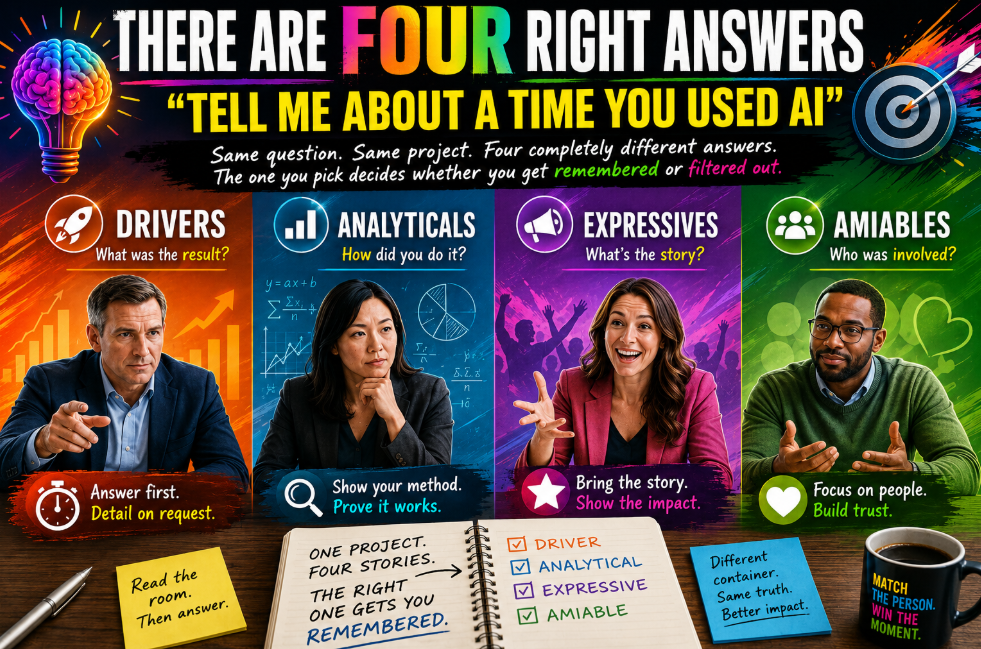
Same question, same project, four completely different answers. The one you pick decides whether you get remembered or filtered out.
The Question That Quietly Filters People Out
You are in the room. The question lands. Tell me about a time you used AI.
Most people answer it exactly one way, because most people only have one way. They reach for the thing they are proudest of and start talking. The stack. The model. The rollout. The team.
Here is the problem. That question has at least four correct answers, and only one of them is correct for the person sitting across the table from you.
Do I tell you about the technical architecture I delivered? The business outcome? The people I pulled together? The energy I brought to a group that thought the whole thing was a distraction?
Those are four completely different stories about the same project. Pick the wrong one and you get a polite nod and a follow-up question about something else. Pick the right one and the person leans forward.
Four People, One Question, Zero Overlap
I use a simple quadrant with my teams called people styles. Four types, and you can usually place someone inside two minutes.
Drivers want the answer. Result, number, timeline. If they want detail they will ask for it, and they will be annoyed if you volunteer it first.
Analyticals want the method. Logic, evidence, how you measured it. Conjecture loses them immediately.
Expressives want the story and the momentum. How did you get people moving? What did it feel like when it landed?
Amiables want the people. Who did you talk to? How did the team handle it? Did everyone come out of this in one piece?
I worked with an executive director once who genuinely did not care what got delivered. Milestones bored him. Adoption numbers bored him. He wanted to know how the conversation with Jackie went, and whether she was okay with the new plan. Years later he wrote me a strong recommendation, because I gave him the thing he was actually listening for.
Read the Room Before You Open Your Mouth
Do the homework first. Pull up their posts, their interviews, their conference talks. A chief data officer who publishes benchmark comparisons is analytical. A chief revenue officer whose feed is full of team shoutouts is expressive.
Then confirm it in the first ninety seconds. Does the meeting open with small talk or with the agenda? Do they cut in for the bottom line or let you build to it? Is the first follow-up question “how did you calculate that” or “who else was involved”?
Most CXOs sit as drivers with an analytical streak. They want the answer first and the proof second, on request. That is your default when you have nothing else to go on.
One Project, Four Answers
Here is the same story four ways. A retailer doing $41 million a month in sales. Their leadership team needed a forward view of next month’s revenue and had nothing to base it on. Asked at 3 p.m. one day, running in production by noon the next.
Driver.
A retailer doing $41 million a month had no forward revenue visibility for their leadership meeting. We built and shipped a trained forecast model in under a day. It runs daily now. Tightening forecast accuracy by a point or two protects roughly $500,000 a year in downstream production waste and lost sales.
Thirty seconds. Stop talking.
Analytical.
We had historical sell-through by SKU and store. We engineered features for seasonality, promotional lift, and store-level variance, trained on prior periods, and validated against holdout months. Accuracy is monitored on a weekly cadence. The value case is bounded on two sides, overbuild waste when plants run twenty percent hot, and lost opportunity when they run under, both measured against actual production runs.
Expressive.
The ask came in at three in the afternoon. I looked at it and thought, we can actually predict this. I sketched the approach, walked it straight to engineering, and gave them a timeline. Seven hours later it was built. Live and emailing executives by noon the next day. Nobody at that company had ever seen something turn around that fast, and the team has been different ever since.
Amiable.
The leadership team was frustrated and the merchandising folks felt like they were guessing every month. I sat with them first to understand what they were missing. Then I brought engineering in early so they were not handed a finished spec and told to build it. Everybody owned a piece. When it went live, merchandising stopped dreading that meeting.
Every one of those is true. Every one is the same project. Only the container changed.
Flexing Is Not Faking
I am a driver. Left alone I would close a meeting in two minutes and send a confirming email.
I worked with a BRM in New York who was the complete opposite. We had a five o’clock meeting and he was somewhere else entirely. I asked if he had eaten. He had not. We went across the street, ordered food, and he talked for an hour about a project that was grinding him down. In the last ten minutes we agreed on the full scope of the work we were partnered to deliver.
In a conference room, that meeting fails. Same content, different container.
You are not changing what is true. You are changing how it is received. And when two people give the same answer, the one who matched the listener is the one who gets remembered.
Do this today. Take your single best piece of work from the last twelve months and write it four times. A thirty-second version for a driver. A methods paragraph for an analytical. A story with momentum for an expressive. A people version for an amiable. Put all four in one file.
The next time somebody asks about your AI work, you will not be composing an answer. You will be selecting one.