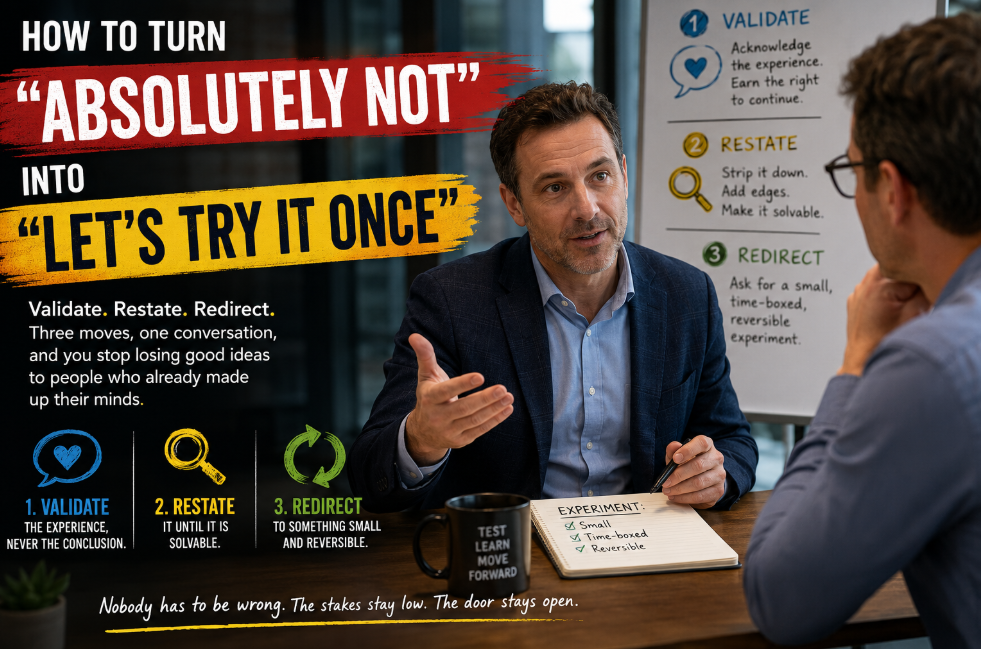
Validate, restate, redirect. Three moves, one conversation, and you stop losing good ideas to people who already made up their minds.
“Absolutely Not” Is a Starting Position
You are in a discovery meeting. You ask an obvious question. Have you thought about bringing that team in to help?
The answer comes back before you finish the sentence. Absolutely not. They are never helpful. We tried that two years ago and it was a disaster.
Most people do one of two things here. They back off and move to the next question, which means the idea dies right there. Or they argue, which hardens the position and costs them the relationship they came in to build.
There is a third option. Three moves, usually inside the same conversation, that take somebody from a flat refusal to a small yes. I call it validate, restate, redirect. It is not a negotiation technique and it is not a persuasion trick. It is a way of getting a real answer out of somebody who is answering from memory instead of from the facts in front of them.
Move One: Validate the Experience, Never the Conclusion
The first move is to confirm you actually heard them. This is where almost everybody gets it wrong, because they either skip it entirely or overcorrect and agree with the whole thing.
Validate the experience. Do not validate the conclusion.
I can appreciate that. If you burned three months on it and got nothing back, I would not be lining up to go again either.
Notice what that does and does not do. It confirms the frustration was earned. It does not concede that the other team is useless, that the approach was wrong, or that it cannot work now. You are agreeing about the past, which is free, and staying completely open about the future, which is the part you need.
Skip this step and everything after it sounds like you are managing them. People know when they are being handled. The validation is what buys you the right to say the next sentence.
Move Two: Restate It Until It Is Solvable
Now hand their complaint back to them, stripped of the emotion and narrowed to something with edges.
This is the move that does the real work. Complaints arrive as verdicts. Everything is broken. IT is slow. Reporting is useless. None of those can be fixed, because none of those are actually problems. They are summaries of a hundred small problems the person has stopped separating.
Watch a vague complaint come apart.
I cannot get any reports to work. Which report? Month end. Where do you go for it? SAP. Can you log in? Yes. Do you have the link? Yes. What do you see? Everything except my own cost centers.
Ninety seconds ago that was “reporting is broken.” Now it is a permissions issue on a specific report for a specific set of cost centers, affecting leaders who need it to make sensitive decisions. That version has an owner, a fix, and a timeline.
Say your restatement out loud and let them correct it. When they nod, the problem is now shared property instead of their grievance.
Move Three: Redirect to Something Small and Reversible
Here is the mistake people make at the finish. They restate beautifully and then ask for a full commitment. Great, so let’s get that team engaged on the program.
You will get the original no back, because you just asked them to relive the thing they told you never to bring up.
Ask for an experiment instead. Three qualities make it easy to say yes to. It is small, it is time-boxed, and it is reversible.
One thought. What if we tried them once, on this single handoff, just as a proof of concept? If it goes the way you expect, we drop it and I will not raise it again.
You have moved the person from no to maybe to fine, let’s test it. Nobody had to admit they were wrong, which is the only reason it works. The escape hatch you handed them is what makes the yes possible, and you will almost never need it.
Three Times This Worked
The department nobody wants to involve. Validate the burned time. Restate it as one specific handoff that currently has no owner. Redirect to a single-cycle pilot with a defined off-ramp. One clean cycle usually resets a two-year grudge.
The month-end reporting complaint. Validate the frustration of making decisions without numbers. Restate it as cost center visibility on one report for four named leaders. Redirect to fixing access for two of them this week and checking back Friday. Small enough that nobody has to fund anything.
The status report the VP will not give up. Validate that the manual version is trusted and the automated one is not. Restate the ask as running both in parallel for three weeks. Redirect to a comparison at the end, where they decide. They almost always kill their own manual process once they can see the two side by side.
Do this today. Pick one blocked item you have written off because somebody shut it down. Write the three lines out before your next conversation. What you are validating. How you are restating it with edges on it. What small, reversible thing you are going to ask for.
The idea was probably fine. It just showed up as a commitment when it needed to show up as an experiment.