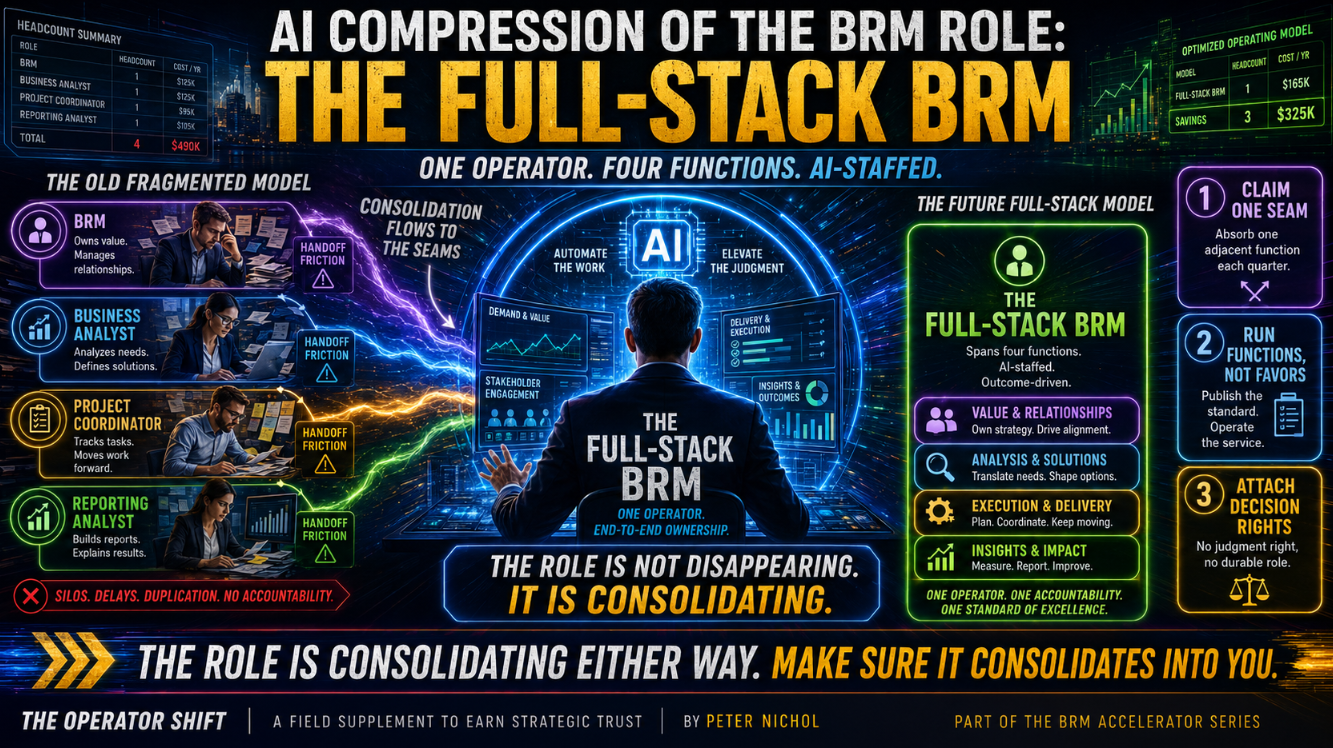
Somewhere above you, a spreadsheet is open. It has a column of roles and a column of costs, and a leader is asking a newer question: how many of these does the work still require?
You have seen the answer forming. Organizations are flattening the middle at the same moment AI is absorbing middle work. In Article 1, I called this the third force of compression: the role boundary dissolving. One operator working with AI can now cover ground that once required a BRM, a business analyst, a project coordinator, and a reporting analyst.
The role is not disappearing. It is consolidating. This article is about how to be the person it consolidates into.
Roles are drawn where handoffs are
Role boundaries were never natural. They were drawn where handoffs were, and handoffs existed because coordination was expensive and artifacts were slow. Requirements took weeks of dedicated craft, so the business analyst existed. Tracking work across slow artifacts consumed a week, so the coordinator existed. Assembling the monthly deck was a job, so the reporting analyst existed. Each role was a bundle of production work wrapped around a thin layer of judgment.
AI unbundles exactly that. The production evaporates, and a thin layer of judgment cannot justify a headcount on its own. So the judgment layers get rebundled into fewer people.
We have watched this movie before. Desktop publishing collapsed typesetting, layout, and paste-up into one designer. The spreadsheet collapsed rooms of clerks into one analyst. DevOps collapsed the wall between building software and running it. Engineering even gave us the word for what comes next: full stack, the developer who spans the layers once the tooling abstracts them. Value work just hit its abstraction moment.
Consolidation flows to the seams
When an organization flattens, the deciding question is rarely asked out loud, but it is always the same: who holds the widest span of defensible ownership per unit of headcount? Not who is most senior. Not who works hardest. Who covers the most surface with real accountability attached.
The full-stack BRM wins that math, and usually wins it before the reorg meeting happens. If you rebuilt the loop from Article 3, look at what you now touch: intake, requirements, the business case, the prioritization decision, the tracking, the value narrative. That footprint already crosses the old lines of the analyst, the coordinator, and the reporter. Consolidation is not decided in the org design session. It is decided months earlier, by who already owns the seams. The new chart just ratifies what practice already proved.
Be precise about what full stack means, because the wrong reading leads straight to burnout. It does not mean four workloads. It means one operator, four functions, AI-staffed. You are not doing the analyst’s job. You are operating the requirements function, with a model producing the drafts and you holding the scope call. The headcount math underneath is brutal and simple: four salaries of production become one salary of judgment plus compute. That is why leadership finds this irresistible, and why it will not slow down.
There is a trap. Absorb the tasks without the decision rights and you have not become full stack. You have become a cheaper department, and cheap production is precisely what compresses next. Span of activity is fragile. Span of accountability is durable.
And none of this is a celebration. Good people sit inside those boundaries. But the lines are moving whether we mourn them or not, and pretending otherwise protects no one.
How to be the one who stays
Move one: claim one seam a quarter. Pick the adjacent function that touches your loop and carries the most production work, because production is what AI absorbs fastest. Status reporting is usually the softest target: pure production, universally resented, defended by nobody. Do not ask for the scope. Take the output. Ship the portfolio status, AI-generated from the tracker and finished with your judgment, and let the result make the argument. One seam per quarter is a sustainable pace. Four at once is how you burn out and botch all of them.
Move two: run functions, not favors. The difference between an overloaded helper and a full-stack operator is a service catalog. For each function you absorb, publish the standard: requirements drafts within two days of intake, status weekly by Friday noon, value quantified quarterly. The catalog makes your span visible, gives scope creep a boundary, and converts you from a person who helps into a function that operates. What is not in the catalog, you do not do.
Move three: attach a decision right to every absorption. This is what separates consolidation from exploitation. Absorb the reporting, and the recommendation at the end of it is yours. Absorb the requirements drafting, and the scope call is yours. Absorb the tracking, and the escalation judgment is yours. If a function comes with no judgment attached, negotiate the right or leave the function where it is, because production without decision rights is just more surface for the next compression to take.
Each seam widens the span. Each catalog entry makes it legible. Each decision right makes it durable.
Your move
So here is this week’s challenge. Name your seam. Identify the adjacent function with the most production and the least defense, and write its first catalog entry in one sentence. You do not need approval to draft a standard.
The Operator Shift lays out the full-stack operating model end to end: which functions to absorb in which order, how to staff each one with AI, where the decision rights sit on the maturity ladder, and how to widen span without widening hours. Articles 1 through 3 built the operator. This is where the operator becomes the org design.
This is Article 4 of 5. Next: proving it. How to turn the speed, the loops, and the span into quantified value leadership can see, and the one-page case that makes the whole system pay.
The role is consolidating either way. The only question is whether it consolidates into you.
Get The Operator Shift here: https://datasciencecio.com/product/operator-shift-supplement/
Explore the full BRM Accelerator Series: https://datasciencecio.com/brm-accelerator-series/