Most BRMs I talk to are already using AI. Almost none have changed how they operate.
The tell is the calendar. If AI made you thirty percent faster and your week looks identical to last year, the speed went somewhere, and it was not into your value. It leaked into more meetings, more polish, more production. Faster inputs, same operating model, same ceiling.
Articles 1 and 2 of this series measured the compression and named the judgment capabilities that replace translation. This one is about the mechanism: how you actually operate differently. The unit of change is not the prompt. It is the loop.
Random acts of AI
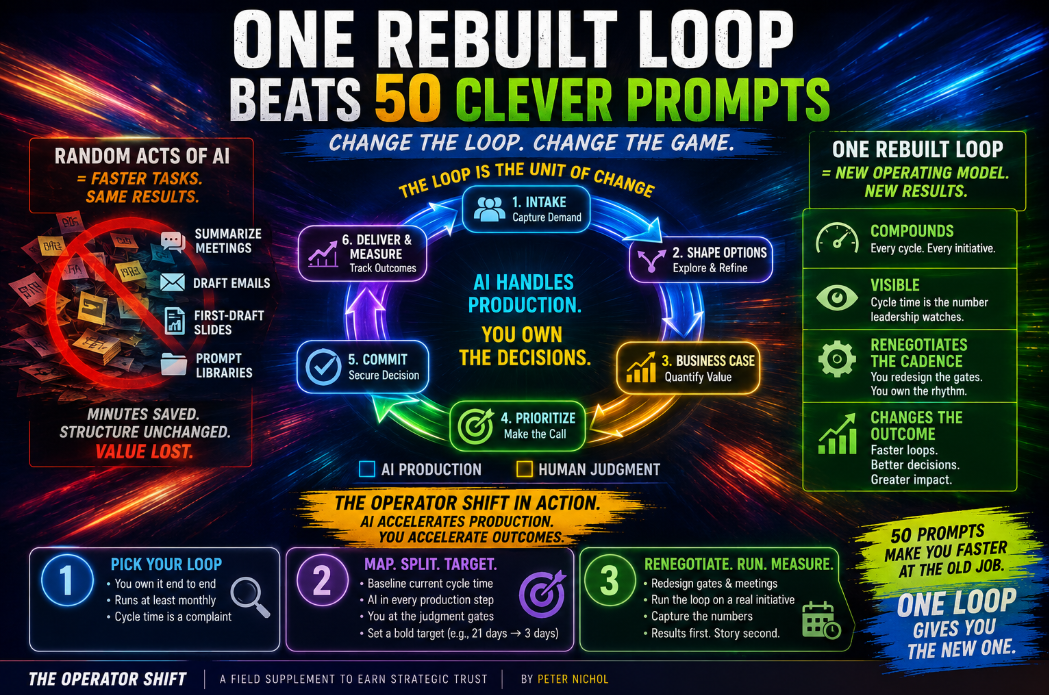
Here is what random acts of AI look like: a summarized meeting, a polished email, a first-draft slide, a prompt library shared on the team channel. Each act saves minutes. None changes the structure, because the structure was never built at the task level.
The traditional operating model was designed around the physics of slow artifacts. Two weeks for requirements set the sprint boundary. Three weeks for a business case set the funding gate. A monthly deck set the steering rhythm. Every handoff, approval, and meeting on your calendar is downstream of those timelines.
Drop AI into individual tasks and the structure simply absorbs the savings. The requirements draft finishes Tuesday instead of in two weeks, then waits eleven days for a meeting scheduled around the old tempo. You got faster; the loop did not. And because cycle time never moved, nobody above you can tell the difference between your fifty clever prompts and your colleague’s none.
The loop is the unit of change
A loop is an end-to-end value chain you own, with a trigger at one end and a committed decision at the other. Demand intake through shaped options through business case through prioritization is a loop. Delivery data through quantified value through executive narrative through funding is a loop. A loop has a start event, an end decision, and a cycle time you can put a number on. That number is the whole game.
One rebuilt loop beats fifty clever prompts for three reasons.
First, loops compound. A prompt saves one task once. A rebuilt loop runs every cycle, forever, and every initiative that flows through it inherits the new speed. You are not saving minutes; you are changing the metabolism of the work.
Second, loops are visible. Nobody above you can see that your drafts got faster. Everybody can see that the business case cycle went from twenty-one days to three, because cycle time is the number that gates funding, and funding is the number leadership watches. Task speed is private. Loop speed is political.
Third, rebuilding a loop forces you to renegotiate the structure around it. When the artifact takes hours, the review built for the two-week artifact becomes absurd, and someone has to redesign the gates, the meetings, and the handoffs. Whoever redesigns the cadence owns the cadence. That is the operator shift in miniature: the role gets redefined either by you, loop by loop, or for you, all at once.
And notice where you sit inside a rebuilt loop. AI takes the production stages. You concentrate at the decision points, which is exactly where the three capabilities from Article 2 live. Value it at the case stage. Decide it at the prioritization stage. Own it at the commitment stage. The loop is not just faster. It is the delivery vehicle for the judgment premium.
The loop rebuild
Step one: pick one loop you own. Three filters. You control it end to end, so changing it does not require a committee. It runs at least monthly, so the rebuild compounds and you get repetitions fast. And its cycle time is already a complaint, so the before and after story has a ready audience. For most BRMs and product owners, demand intake through business case through prioritization passes all three.
Step two: map it, split it, target it. Baseline the current cycle time honestly, waiting included. List every stage, then tag each one production or judgment, the same two columns from the Article 1 audit. Put AI inside every production stage: transcript to draft requirements, data to value model, case to executive narrative. Reserve yourself for the judgment gates. Then set a target that forces redesign rather than tweaks. Twenty-one days to three is the right shape of ambition. A target you can hit by typing faster is not a rebuild.
Step three: renegotiate the cadence, then run it live. This is the step everyone skips, and it is the one that makes the rebuild real. A three-day case that waits eleven days for a monthly gate is still a fourteen-day loop. Take the new cycle time to whoever owns the gate and propose the new rhythm: async review in forty-eight hours, decision windows twice a week, steering by exception. Then run the loop on the next real initiative and capture the numbers, because those numbers are the raw material for Article 5.
One warning. Do not announce a transformation. Ship a loop. Results first, story second.
Your move
So here is this month’s challenge. Pick your loop by Friday. Baseline it next week, honestly, waiting included. You do not need permission to measure, and the measurement alone will show you where the rebuild starts.
The Operator Shift contains the complete loop-rebuild method: how to sequence the stages, where the judgment gates go, how to set targets that force redesign, and the scripts for renegotiating cadence with the people who own the gates. Article 2 named what to build. This is the manual for building it at operating tempo.
This is Article 3 of 5. Next: the full-stack BRM, what happens when one operator covers the ground of four roles, and how to be the one who stays.
Fifty prompts make you faster at the old job. One loop gives you the new one.
Get The Operator Shift here: https://datasciencecio.com/product/operator-shift-supplement/
Explore the full BRM Accelerator Series: https://datasciencecio.com/brm-accelerator-series/