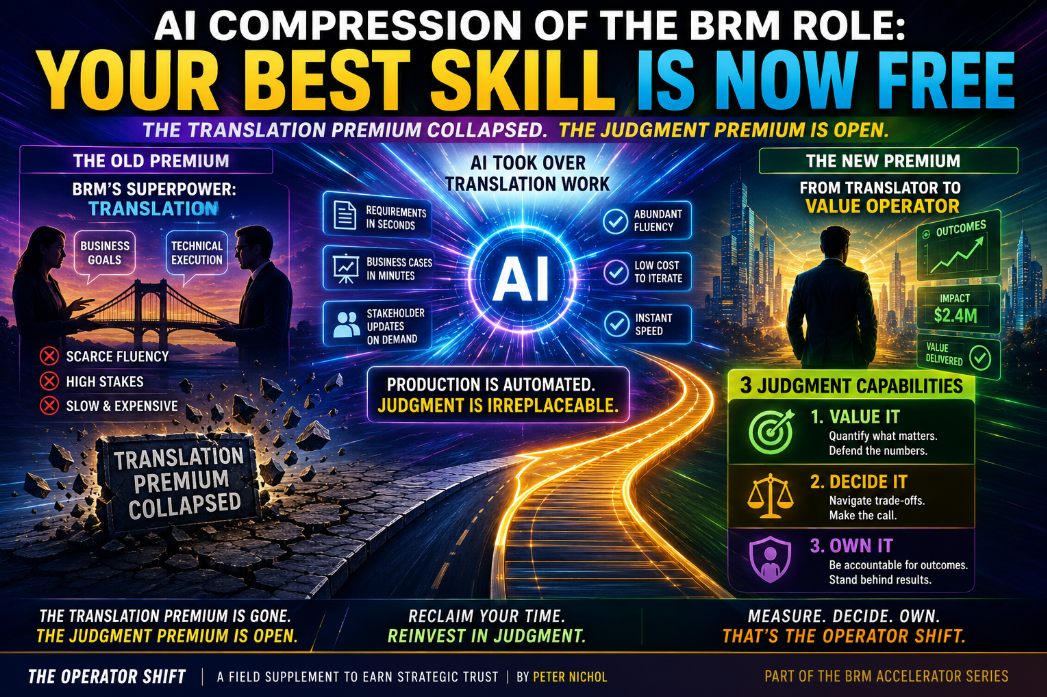
In the first article of this series, I named what is happening to the business relationship management role. AI is not augmenting it. It is compressing it, and the middle of the job, the translation work, is compressing first.
This article goes deeper on that first collapse, because it holds the key to everything else. The BRM role was built on a translation premium: the rare ability to speak fluent business to technologists and fluent technology to executives. That premium paid for two decades of careers. It is now gone. What replaces it is worth more, but only if you build it deliberately.
The premium that built the role
The translation premium existed for three reasons. Fluency in both languages was scarce; few people could be credible in a steering committee at nine and a sprint review at ten. Mistranslation was expensive; a requirement misunderstood in week two became a failure discovered in month nine. And translation was slow; meetings, documents, and revision cycles, all paid for in salary and headcount.
Scarce, high stakes, slow. That is the recipe for a premium, and the role collected it in every job description that asked for a bridge between business and IT.
Large language models broke all three conditions at once. Fluency is now abundant: a model turns a rambling stakeholder transcript into structured requirements, or an architecture constraint into an executive paragraph, in seconds, in both directions, at midnight. The stakes dropped because iteration is nearly free: a bad draft now costs a minute, not a quarter. And the time collapsed entirely. When a scarce, high-stakes, slow skill becomes abundant, cheap, and instant, its price does not drift down. It falls to zero.
Translation was never the product
Here is the part that took me time to see. Translation was never the product. It was the ticket.
Executives never wanted your translation. They wanted certainty about what to do next, and translation was how the raw material for that decision got manufactured. Producing the material put you in the room. Being in the room let you shape the decision. The premium was attached to the access, and the access was attached to the production. AI severed that chain. The material now manufactures itself, which means production no longer buys a seat.
But notice what did not change. The decision still has to be made. Someone still has to say what the initiative is worth, which option to fund, and who stands behind the outcome. Organizations will hand a model the drafting. They will not hand it the deciding, for a structural reason that has nothing to do with model capability: a model cannot be accountable. It cannot defend a number in a budget review, absorb the consequences of a wrong call, or restore confidence after a miss. Accountability requires a name, and the name has to belong to a person.
So the premium did not disappear. It relocated, from converting meaning to committing to it. The scarce skill is no longer saying it in both languages. It is being willing to sign it in one.
That relocation explains something you may have noticed. The BRMs losing ground right now are often the best translators, doubling down on fluency at the exact moment fluency went free. The BRMs gaining ground are letting AI do the converting and reinvesting the recovered hours in three capabilities that translation used to crowd out.
Value it. Decide it. Own it.
The three judgment capabilities that replace the translation premium are valuation, trade-offs, and accountability. Each one gets more valuable as AI gets better, and each one can be started this week.
Capability one: valuation. Knowing what work is worth in numbers an executive can defend, and being willing to defend them. AI can build the model; it cannot vouch for the assumptions. This week, take one live initiative and put a defensible number on it: hours avoided, dollars unlocked, risk retired, time recovered. Let AI draft the math in an hour, then spend your time pressure-testing the assumptions, because the assumptions are what you will be asked about.
Capability two: trade-offs. Choosing among defensible options when cost, speed, risk, and politics collide, including the option nobody wants to name: no. AI generates options at volume, which makes analysis abundant and the recommendation scarce. This week, find one decision that has been circling for two weeks, use AI to lay out the options and consequences in an afternoon, then make a recommendation with your reasoning and what it trades away attached.
Capability three: accountability. Attaching your name to outcomes instead of artifacts. AI can draft the business case; only a person can stand behind the realized number. This quarter, pick one deliverable and commit to the result: a realized benefit, a held date, a defended figure. Not “I produced the case” but “I own the outcome.”
None of this requires permission, a new title, or a reorg. It requires the hours translation used to consume, which AI just handed back to you. The question is whether you reinvest them or refill them with faster production.
Your move
So here is this week’s challenge. Stop selling translation. Pick one of the three capabilities, run its move, and make the result visible to someone above you.
The Operator Shift maps this transition in full. It includes the updated BRM maturity ladder, a modern replacement for the 2015 model, showing where each judgment capability sits, what mastery looks like at every level, and how to climb while the compression accelerates. Article 1 told you to measure your exposure. This is where you start rebuilding on the other side of it.
This is Article 2 of 5. Next: rebuilding your operating loops, and why one rebuilt loop beats fifty clever prompts.
The translation premium is gone. The judgment premium is open. Claim it.
Get The Operator Shift here: https://datasciencecio.com/product/operator-shift-supplement/
Explore the full BRM Accelerator Series: https://datasciencecio.com/brm-accelerator-series/