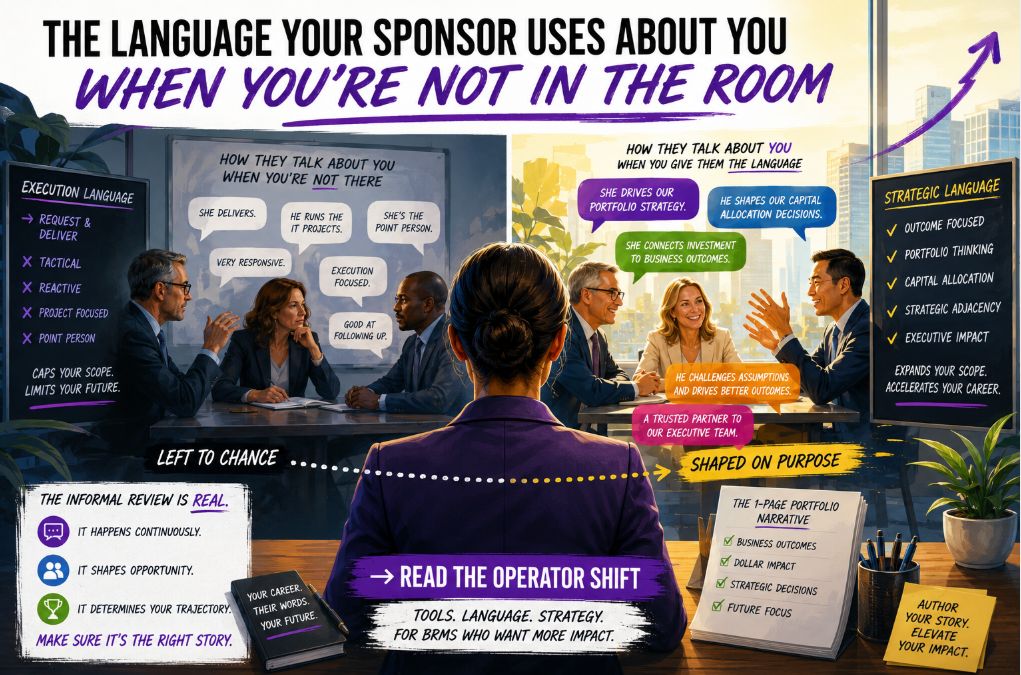
Your career is not decided in the meetings you attend. It is decided in the sentences your sponsor uses about you in meetings you don’t. Most BRMs are leaving those sentences to chance, and the consequences are usually invisible until they become permanent.
Every BRM career has two performance reviews. One is the formal review your manager writes once a year, which you read and sign and file. The other one is informal, continuous, and far more consequential. It happens in the sentences your sponsor uses about you when you are not in the room.
The second review is the one that determines whether you get pulled into bigger work, whether you survive a reorganization, and whether your skip-level executives have any sense of who you are before they meet you. It is not written down. It is not scheduled. It accumulates in fragments — half a sentence here, a paragraph there, a recommendation in a closed-door conversation. Over time, the fragments harden into a description of you that travels through the organization without your awareness.
The uncomfortable part is that most BRMs leave this entirely to chance. They invest enormous energy in the formal review and almost none in shaping the informal one. The result is predictable. The formal review describes them in language they helped author. The informal review describes them in language their sponsor improvised, often poorly, often inconsistently, and almost always in terms that map to the lowest-level interpretation of what they do.
The reason the language usually defaults low is structural. When a sponsor describes someone they manage to a peer, they use whatever vocabulary is available. The available vocabulary for a typical BRM is execution language. “She delivers.” “He runs the IT projects for that group.” “She is the point person on the data initiatives.” These are not bad descriptions. They are also descriptions that cap your scope at execution work indefinitely, because they signal to the listener that you are operating in the request-and-deliver zone.
The practitioners who break out of this pattern do something specific and counterintuitive. They author the language themselves. Not as a performance, but as an artifact. They give their sponsor a written description of their portfolio, in business-unit framing, that the sponsor can read once and then repeat. They use the language of capital allocation, of portfolio thesis, of outcome delivery, of strategic adjacency. They never name the technology stack first. They name the business outcome and treat the technology as the means.
The first time you hand a sponsor a paragraph like this, the sponsor reads it and adjusts the language they use internally about your work. The second time, they adjust the language they use externally, in conversations you are not part of. By the third or fourth iteration, the language starts traveling. Executives you have never met begin to have a description of your work that matches the description you wrote.
The shift is not about marketing. It is about closing a structural gap in how organizations talk about IT work. Most sponsors do not have the vocabulary to describe what a senior BRM actually does. They have the vocabulary to describe what a junior BRM does, because that is the role most of them have seen up close. If you do not give them better vocabulary, they will use the vocabulary they have, and the vocabulary they have will cap you.
The artifact that accomplishes this is mundane. A single page, written in plain prose, describing the portfolio in business terms, the three to five outcomes you are responsible for, the dollar figures you are accountable for, and one or two specific examples of strategic decisions you have shaped. It takes about two hours to write the first version. It takes twenty minutes to update each quarter. Most BRMs never write it.
This is the kind of artifact that distinguishes practitioners operating at the upper levels of the role from practitioners operating in the middle. Not because the upper-level practitioners are doing different work. Because they have made the work legible to people who were not in the room when it happened.
The Operator Shift supplement covers the full set of these artifacts and the language conventions that travel best across executive layers. The five-level maturity model that organizes them. The specific phrases to avoid because they cap your scope, and the specific phrases that move the description upward. The cadence for refreshing the artifacts so they stay current without becoming a maintenance burden.
Your formal review is written for the file. The informal review is written for the rest of your career. The first one you can read. The second one you can shape, if you stop leaving it to chance.