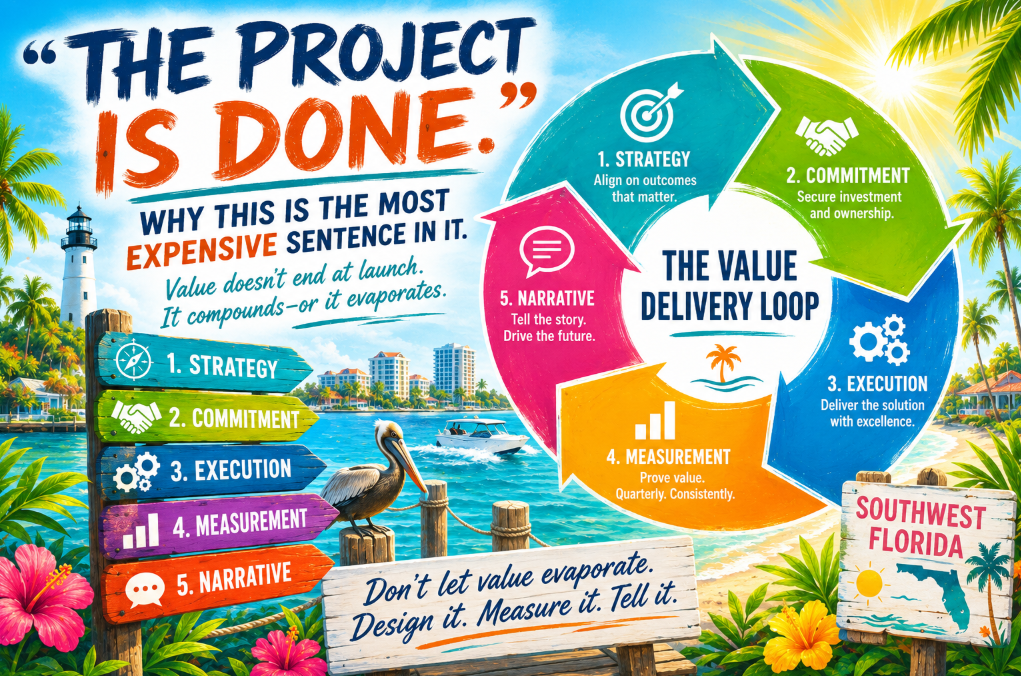
It sounds like a milestone. It is actually a handoff with no recipient. The phase that follows is where outcomes either compound or evaporate, and most of the time, they evaporate.
“The project is done.” Four words. The most expensive sentence in any IT organization.
It sounds like a milestone. It is actually a handoff with no recipient. The sentence is usually spoken at a closing dinner or a retrospective meeting, with relief on the team’s part and acknowledgment from the sponsor. The work is shipped, the milestone is hit, the team rotates to the next initiative. The program enters what most organizations call its sustainment phase, which is the phase that has no owner and no operating cadence.
This is the phase where value either compounds or evaporates. Most of the time, it evaporates.
I have watched programs ranging from $5M to $50M+ ship cleanly and then disappear from the organizational memory within twelve months. The work was done. The work was paid for. The work was real. None of that was sufficient. By the time someone asked, eighteen months out, what the program had returned, the answer was a vague gesture toward improvements that had become indistinguishable from the rest of the business.
The pattern is consistent. “The project is done” gets said. The team scatters. The measurement infrastructure was scheduled to come online in the post-launch phase, which was no one’s specific responsibility. The baseline document, if it existed at all, was signed by people who have since rotated. The sponsor who funded the work has moved to a new role. The new sponsor inherits the program with no context, and reasonably treats it as a sunk cost.
The sentence is the symptom. The system underneath is the problem.
This is what the value delivery loop is built to catch. Five phases, not three. Strategy, commitment, execution, and then measurement and narrative. Most IT organizations operate a tight three-phase loop and treat the last two phases as optional cleanup. The two optional phases are the ones that determine whether a program compounds or evaporates.
Measurement is the harder of the two to staff. Not because measurement is technically hard, but because the team that built the program is not the team that measures it. Measurement requires a quarterly cadence, a named owner, and a finance partner who confirms the numbers independently. None of that exists by default. It has to be designed in at intake, before the work begins. Adding it after the team scatters is almost always too late.
Narrative is the harder of the two to write. The reason has nothing to do with writing skill. The reason is that the people who should write it have already moved to the next thing. The work is shipped. The story is now someone else’s problem. It is not someone else’s problem. The sponsor who funded the program is going to be asked about it eighteen months out, by an executive who was not in the room when it launched. If the narrative is not written, the sponsor improvises. Improvised narratives age poorly.
The program that compounds is the one where someone took ownership of these two phases before “the project is done” was ever said. The narrative was drafted before launch. The measurement scaffolding was signed off at intake. The post-launch operating cadence was on the calendar before the closing dinner.
Deliver Real Value is the book for the second two phases. It lays out the value delivery loop in full — all five phases, with the specific artifacts and operating rhythms that turn a shipped project into a compounding outcome. The first three phases are familiar territory for any competent BRM or PO. The last two are where the role pays differently.
“The project is done” is the sentence to start catching in your own steering committees. When you hear it, the work is finished. The outcome is only beginning.