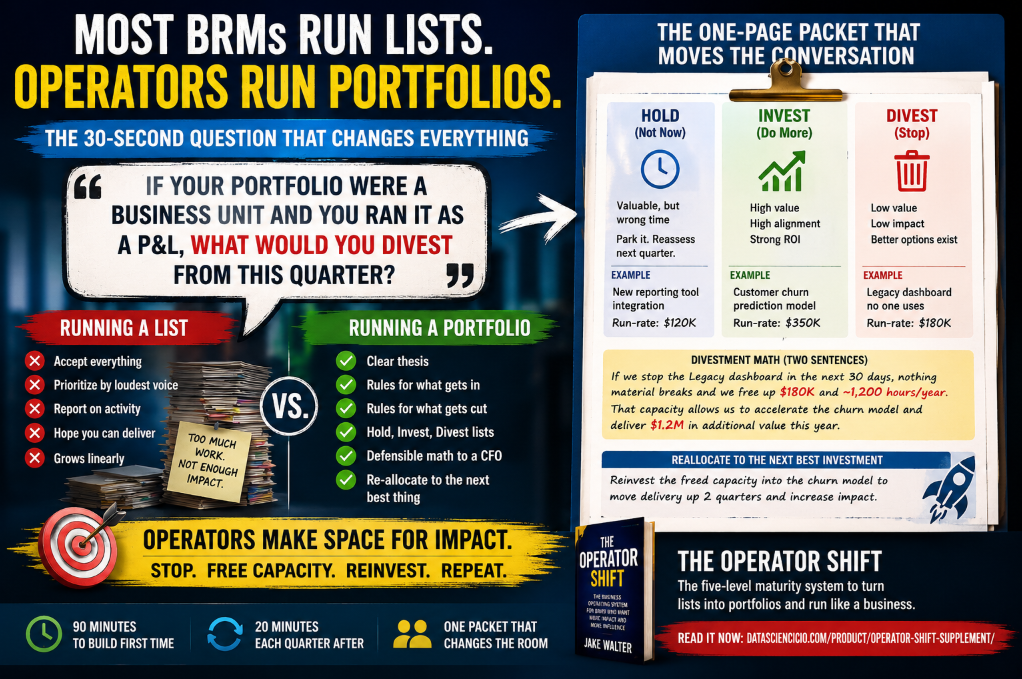
Most BRMs are running a list and calling it a portfolio. The question that separates the two takes thirty seconds and explains a decade of career ceilings.
There’s a question I now ask in the first thirty minutes of any BRM coaching conversation. It does more diagnostic work than any other single prompt I’ve found.
“If your portfolio were a business unit and you ran it as a P&L, what would you divest from this quarter?”
About nine out of ten practitioners can’t answer it. Not because they’re bad at the role. Because no one taught them to think this way. The role is structured to reward stewardship of what already exists. Divestment isn’t on the calendar. Divestment isn’t in the operating model. Divestment is what business unit leaders do, and BRMs are usually not framed as business unit leaders, even when they are running ten to twenty initiatives with seven and eight figures of value attached.
This is the portfolio gap. It’s the difference between operating a list and operating a portfolio.
A list is what you get when you accept every request that comes in, ship what you can, defer what you can’t, and report on activity at the end of the quarter. A list grows linearly. A list is what most BRMs are managing whether they call it a portfolio or not.
A portfolio is something different. A portfolio has a thesis. It has rules for what gets in. It has rules for what gets cut. It has a hold list, an invest list, and a divest list, and the math behind each is defensible to a CFO who has never met you. A portfolio gets reviewed quarterly with a question that lists never get asked: what are we no longer going to do, and what does that free up?
The reason most BRMs are running lists instead of portfolios isn’t ability. It’s framing. Their sponsor frames them as a translator. Their operating model rewards delivery throughput. Their performance review measures things shipped, not things stopped. The system is pointed at list management.
Operators reframe the system. Quietly, in writing, before the meeting. They show up to portfolio reviews with three lists, not one. They name what they’re going to stop. They calculate the freed capacity in hours and dollars. They re-allocate it to the next investment. They do this whether or not they were asked to.
What this looks like in practice is a one-page packet. Three columns: hold, invest, divest. A line item under each with a defensible run-rate number. Two sentences explaining the divestment math. A reallocation proposal at the bottom. The packet takes about ninety minutes to build the first time, twenty minutes per quarter after that. It is the single artifact that most reliably moves the conversation from delivery hygiene to capital allocation.
The first time you do this in a portfolio review, two things happen. Your sponsor pauses, because they weren’t expecting to be presented with stop-decisions. And the room shifts, because someone has just demonstrated they are running a business, not a request queue.
I won’t lay out the full portfolio operating model here. The five-level maturity work in The Operator Shift covers it in detail, including the specific divestment criteria, the conversation script for proposing a stop to a sponsor who funded the original work, and the quarterly cadence that turns a list into a portfolio over about two cycles.
Here’s the part I’ll give you to start with.
Open your initiative tracker. Pick the three lowest-value items by defensible run-rate. For each one, write two sentences: what would happen if we stopped this in the next thirty days, and what would the freed capacity allow us to start. That’s a portfolio review in miniature. It takes about an hour the first time you do it.
If that hour produced three uncomfortable conversations you’re now thinking about having with your sponsor, the diagnostic worked. Most BRMs run lists their entire careers because the divestment conversation never gets started. The conversation is the difference. The conversation is what The Operator Shift is for.