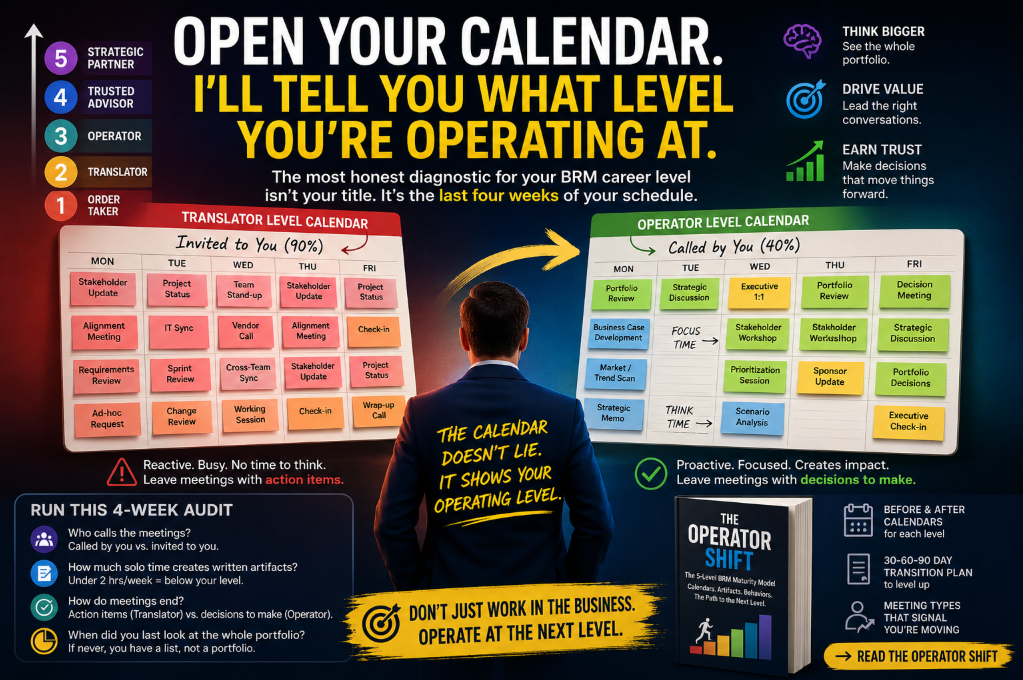
The most honest diagnostic for your BRM career level isn’t your title. It’s the last four weeks of your schedule.
If you handed me your last four weeks of meetings, I could tell you what level of the role you’re operating at within ten minutes. Not your title. Not your scope on paper. The actual level — the one the system pays for, the one your sponsor uses to decide whether to bet bigger.
This is the diagnostic I now run at the start of every coaching engagement. The calendar is the most honest artifact in any IT leader’s life. It cannot be performed. It cannot be retroactively edited for a slide deck. It records, with brutal accuracy, what you actually believed was important during the only resource you cannot get more of.
Most mid-career BRMs and IT product owners have a calendar that tells the same story. Heavy on translation work. Heavy on stakeholder updates. Heavy on meetings they were invited to because someone needed an IT voice in the room. Light on portfolio review. Light on written artifacts produced solo. Light on time blocked for thinking.
That calendar belongs to someone operating at level two or three of the role. The next level up has a different shape.
I won’t walk through the full five-level model here. That’s what the supplement is for. Here’s the part of the diagnostic I’ll give you free.
Run this audit on your last four weeks.
What percentage of your meetings were called by you, versus invited to you? At the Translator level, the ratio is usually 10/90. At the Operator level, it’s closer to 40/60. The shift isn’t about being controlling. It’s about whose questions you’re working on.
How many hours did you spend in solo work that produced a written artifact — a one-pager, a business case, a portfolio review, a strategic memo? If the answer is under two hours per week, you are operating below the level you’re probably being paid for. The role pays for written points of view. Most BRMs don’t produce them because they’re not on anyone’s calendar.
How many of your meetings ended with you committing to do something, versus committing to think about something? Translator-level BRMs leave meetings with action items. Operator-level BRMs leave meetings with decisions to make. The grammar of the next move is the signal.
When was the last time you blocked an hour to do nothing but look at your portfolio as a whole? Not by initiative. Not by sponsor. The whole thing. If the answer is “never” or “I can’t remember,” you don’t have a portfolio yet. You have a list.
These four questions are diagnostic, not prescriptive. They tell you where you are. They don’t tell you what to do about it.
One more pattern worth naming. The BRMs I’ve watched move from Translator to Operator in under eighteen months almost always remove the same three things from their calendar in the first sixty days. Standing status meetings that produced no decisions. Standing “alignment” meetings that should have been written notes. Recurring stakeholder check-ins where they were the only IT presence. Removing those three opens five to seven hours per week. That capacity is what makes the rest of the shift possible. You cannot operate at the next level on top of the current level’s calendar.
The harder question, and the one that takes the work, is what an Operator-level calendar actually looks like week by week. What gets added. What gets removed. Which standing meetings die in the first thirty days. Which artifacts replace which conversations. How the ratio of called-by-you to invited-to-you shifts, and why your sponsor stops resisting that shift after the second quarter.
That’s the part of the diagnostic that lives inside The Operator Shift. The full five-level maturity model. The before-and-after calendars for each level. The thirty-day, sixty-day, ninety-day transition plan to move from one level to the next, with the specific behavioral shifts and meeting types that signal you’re moving.
If your calendar told you something you weren’t expecting in the audit above, that’s the signal. Most BRMs don’t audit their own calendar because the answer is uncomfortable. The discomfort is the data.
Open the supplement when you’re ready to act on it.