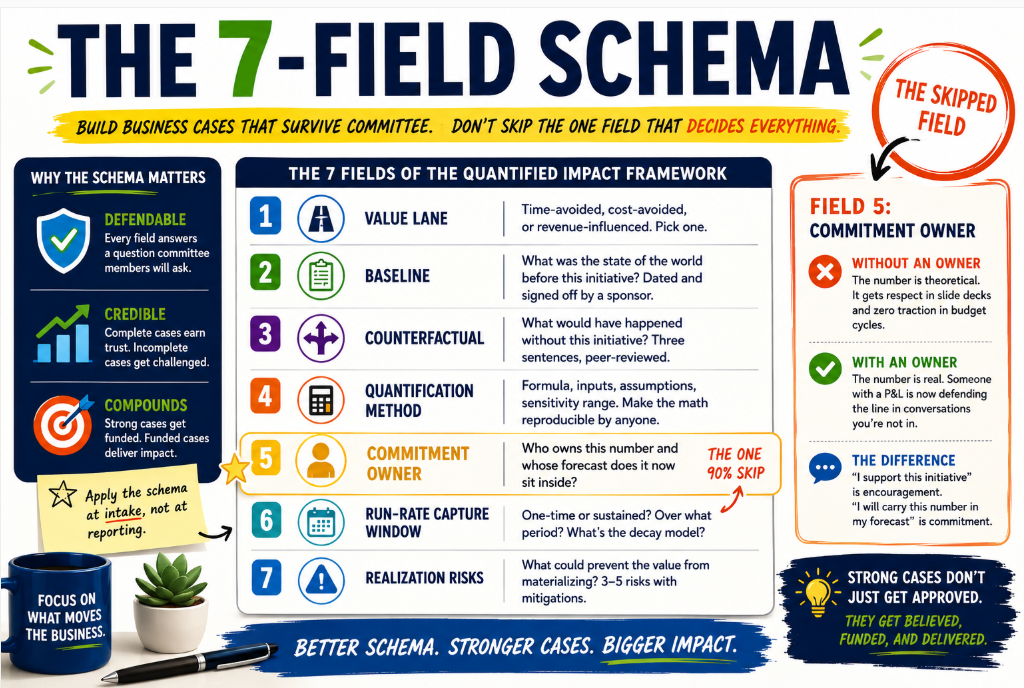
The math is rarely what kills a business case in committee. The schema is.
Most BRMs build their business cases the same way. A sponsor asks for the value of an initiative. The BRM goes back to their desk, opens a spreadsheet, runs the numbers, fills in the slide, sends it back. The case looks defensible. The math checks. The sponsor agrees.
Six months later, the case dies in committee. Not because the numbers were wrong — because the schema underneath the numbers was incomplete. A skeptical CFO asks a question the BRM didn’t anticipate. The sponsor can’t defend the line because the sponsor doesn’t have the field that would have defended it.
This is the schema problem in value quantification. The Quantified Impact Framework solves it with a 7-field business value schema applied at intake, not at reporting. Most BRM teams adopting the QIF for the first time skip one of the fields. The skipped field is the one that decides whether the number lives or dies.
This post walks through the schema, the order I fill in the fields, the field that gets skipped, and three examples: one strong case, one weak case, and one that should have died in committee but didn’t because of a single move at intake.
The seven fields
The 7-field schema is the spine of a defensible business case. Each field exists to defend against a specific challenge that will come up in committee. Skip a field and you’ve skipped a defense.
Field 1: Value lane. Time-avoided, cost-avoided, or revenue-influenced. Pick one. The single most common mistake in BRM business cases is claiming multiple lanes for the same dollar, which double-counts the value and gets the whole case challenged the moment a CFO notices. The lane is the audience: time-avoided defends with operations leaders, cost-avoided with finance, revenue-influenced with the business. The lane determines what the case has to prove.
Field 2: Baseline. What was the state of the world before this initiative? Specifically, in writing, dated, signed off by a sponsor. A case without a signed-off baseline at intake is a case that cannot be defended at outcome, because every challenger gets to argue the improvement would have happened anyway. The baseline must pre-date the work.
Field 3: Counterfactual. What would have happened without this initiative? Three sentences, peer-reviewed at intake. The counterfactual is the field most teams skip on the first pass and the one that pays the highest dividend during executive review. Without it, every committee skeptic gets to argue the value was inevitable.
Field 4: Quantification method. How exactly was the number calculated? Formula, inputs, assumptions, sensitivity range. This is the field most BRMs over-engineer. The discipline isn’t to make the math sophisticated. It’s to make the math reproducible by anyone with the inputs.
Field 5: Commitment owner. Who has agreed to own this number going forward, and whose forecast does it now sit inside? This is the field 90% of teams skip on the first pass. More on this below.
Field 6: Run-rate capture window. Over what period does the value accrue? One-time event, or sustained run-rate? If sustained, what’s the decay model? The answer affects how the value shows up in financial reporting and how the case has to be defended in future quarters.
Field 7: Realization risks. What could prevent the value from materializing? Three to five risks, named, with mitigations. The schema includes this field because a case that doesn’t name its risks reads as either naive or political, neither of which executives extend strategic credit to.
The skipped field
Field 5 — commitment owner — is the field that decides whether the number lives or dies.
The other fields are mathematical. They describe what the value is and how it was calculated. Field 5 is the only one that describes who owns the value going forward. Without an owner, the number is theoretical. It gets respect in slide decks and zero traction in budget cycles. With an owner — someone with a P&L who has agreed the number sits inside their forecast — the number is real. Someone is now defending the line in conversations the BRM isn’t in.
The reason teams skip the field is that filling it requires a different kind of conversation than the rest of the schema. Fields 1 through 4 are conversations between the BRM and the analyst. Field 5 is a conversation between the BRM and the sponsor where the sponsor commits, in writing, that they will carry this number forward in their forecast. The sponsor has to actually say yes. Most BRMs avoid the conversation because they assume the sponsor’s support means the sponsor’s commitment. It doesn’t.
A sponsor saying “I support this initiative” and a sponsor saying “I will carry this number in my Q3 forecast and be accountable for it” are two different statements. The first is encouragement. The second is the commitment field.
Three examples
Example 1: Strong case. A BRM proposes consolidating three duplicate data integration platforms into one. Lane: cost-avoided. Baseline: signed-off three-platform spend of $2.4M annually. Counterfactual: peer-reviewed, three sentences explaining why duplicate spend would have persisted in the absence of consolidation. Method: vendor contract reduction plus reduced internal support FTE, fully reproducible. Commitment owner: the IT operations VP has committed $1.6M in cost reduction to their Q2 forecast. Run-rate: sustained, with a 5% annual decay model for inflation. Risks: three named, with mitigations. The case survives every challenge in committee because every challenge has a pre-built defense.
Example 2: Weak case. A BRM proposes a new analytics platform that will “drive better decisions.” Lane: unclear, sometimes described as time-avoided (analyst hours reduced), sometimes as revenue-influenced (better decisions, better outcomes). Baseline: estimated, not signed off. Counterfactual: not present. Method: a high-level model with no sensitivity range. Commitment owner: none — the sponsor “supports” the initiative but hasn’t committed any number to their forecast. The case dies in the first committee challenge because the value is theoretical and the case has no defender. The math may be right. It doesn’t matter.
Example 3: Should have died, didn’t. A BRM proposes a workflow automation that’s hard to quantify. The lane is ambiguous. The baseline is partial. The method is imperfect. The case should be struggling. But the BRM filled in Field 5 at intake — they pushed the sponsor for a written commitment of $800K in process efficiency to the sponsor’s Q3 forecast. The committee challenged the math. The sponsor defended the case anyway, because the number was now in their own forecast and walking away from it would have cost them politically. The single move — the commitment field — kept the case alive.
The fix
The fix isn’t to write better business cases. It’s to fill in Field 5 at intake, before any work begins, with a written commitment from a sponsor whose P&L the number now sits inside.
This is harder than it sounds. The conversation is uncomfortable. The sponsor will resist committing. The temptation is to skip the conversation and let support stand in for commitment. Resist the temptation. A case without a committed owner is not a case. It’s a hypothesis with arithmetic.
The discipline is also self-enforcing. Once you start running every initiative through Field 5 at intake, you’ll discover that some of the cases your team is investing in have no sponsor willing to commit. That’s a portfolio signal, not a business case signal. The initiatives that can’t get a Field 5 owner are the initiatives that shouldn’t be in the portfolio.
Build the schema. Fill the field. The math survives.
The full schema in intake order, with worked examples in all three value lanes and the templates I use at program intake, is in Quantify Your Impact.