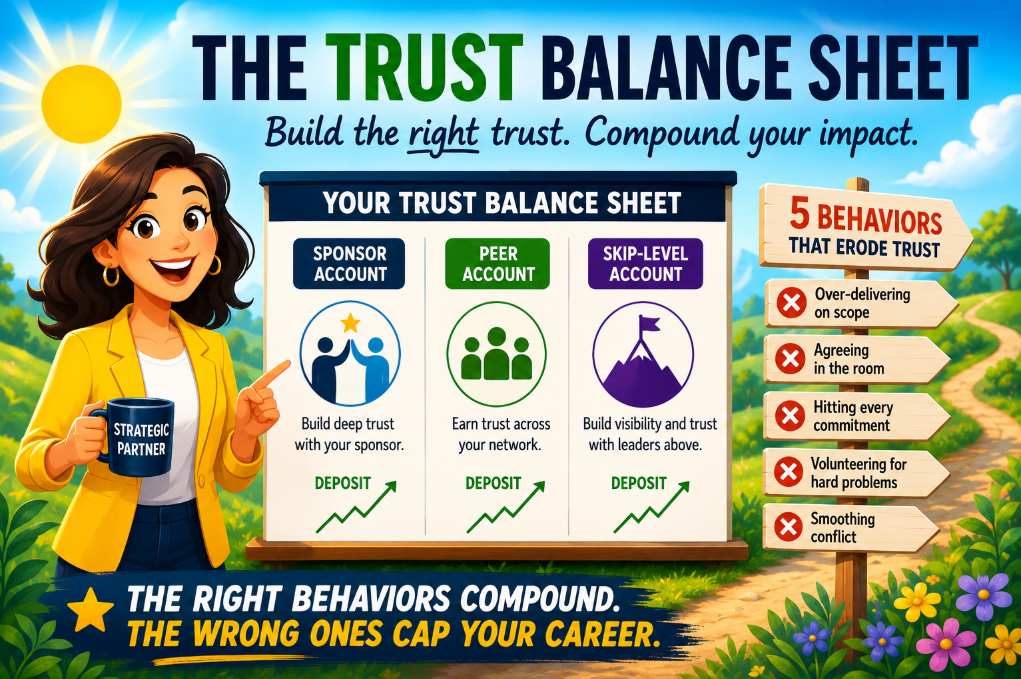
Trust isn’t a soft skill. It’s an asset with a balance sheet. The five behaviors that built your career through year five are the same ones capping it at year ten.
Most BRMs hit a ceiling around year seven that no one named for them when they got hired. The work is good. The reviews are positive. The sponsor describes them as “indispensable” in the same review where they don’t get put up for the next level.
This isn’t a performance problem. It’s a trust problem — and specifically, it’s a problem with the kind of trust the BRM has built.
Trust isn’t a soft skill. It’s an asset with a balance sheet. Deposits and withdrawals. Running totals. Compound interest in the right accounts and compound liability in the wrong ones. The reason most BRMs cap out at year seven is that the behaviors they’ve been using to build trust for the first decade are the wrong behaviors for the second decade. The asset they’ve been building stops paying interest somewhere around level three.
This post walks through the framework I use for executive trust — the trust balance sheet — and then names the five behaviors most BRMs default to that look like trust deposits and actually function as withdrawals. The fix isn’t to work harder. The fix is to work differently, on a smaller set of behaviors that compound.
What a trust balance sheet actually is
A balance sheet has accounts. Assets and liabilities. A running total maintained whether you’re tracking it or not. The accounts compound — assets accrue value when you don’t draw on them, liabilities accrue cost when you don’t address them.
The trust balance sheet for a BRM has three accounts.
The sponsor account is the one most practitioners pay attention to. It’s the trust you’ve built with the person you report to or the executive who owns your portfolio of work. Most BRMs run a healthy balance here because the day-to-day work creates constant interaction. Deposits happen by accident.
The peer account is the trust other BRMs, product owners, IT leaders, and counterparts in the business hold for you. It’s the network that gets you context, intel, and the early read on where the org is moving. Most practitioners under-invest here because peer relationships don’t create urgent meetings. They’re easy to neglect.
The skip-level account is the trust held by people two levels above you — your sponsor’s peers, your sponsor’s boss. This is the account that matters most for promotion and survives reorganizations. It’s also the one almost no BRM builds intentionally. You’ve usually never met these people. The only way you exist in their minds is through your sponsor’s language.
Healthy practitioners build all three. Most BRMs run one healthy and the other two on overdraft. They feel the friction in meetings they don’t get invited to. They can’t read the statement that explains the friction.
The five behaviors that look like trust deposits and aren’t
Here’s the part that’s counter-intuitive. The behaviors most BRMs reach for when they want to build trust look right and feel right. They’re the behaviors performance reviews praise in years one through five. They are also the behaviors that quietly cap your career somewhere around year eight.
Behavior 1: Over-delivering on scope. You take on more than you committed to. You absorb tickets that aren’t yours. You stay late to clean up after someone else’s miss. The sponsor sees you as reliable, as the person who’ll absorb whatever falls. This builds execution trust. It does not build strategic trust. The sponsor learns to route capacity to you. The capacity crowds out the work that would have demonstrated judgment.
Behavior 2: Agreeing in the room. You hold disagreements for the one-on-one or for the post-meeting Slack. In the meeting where the decision is being made, you support the sponsor publicly. This feels like loyalty. It signals to the room that you have no independent point of view — that you’re an extension of the sponsor’s preferences rather than a strategic partner. Executives notice. They route the seat to people whose disagreement is on the record.
Behavior 3: Hitting every commitment. You under-promise so that you always over-deliver. Your hit rate is 100%. This sounds like discipline. It reads to executives as risk aversion. The only way to hit every commitment is to commit only to what’s already safe. The signal you want to send is: this person makes bigger forecasts, sometimes misses, and explains the miss with the same rigor they use for the hit.
Behavior 4: Volunteering for hard problems. You raise your hand when a difficult initiative needs a lead. You’re known as the person who takes the things no one else wants. This builds execution capacity but caps strategic adjacency. The pattern reads as: this person says yes. People who say yes get more requests. People who say yes thoughtfully — selectively, with a thesis — get the strategic seat.
Behavior 5: Smoothing conflict. You translate between groups. You absorb friction so the principals don’t have to feel it. You’re known as the diplomat who keeps things moving. This builds the trust extended to a translator. It’s the wrong trust for promotion into strategy. Strategists don’t smooth conflict. They surface it cleanly and force resolution.
Each of these behaviors is rational. Each works for the first five years. Each caps the next ten.
The behaviors that actually compound
The five behaviors that build strategic trust look uncomfortable from the inside. They feel like they cost you something in the moment. The cost is the deposit.
Behavior 1: Disagreeing in writing in a one-on-one. Once a quarter, surface a disagreement with your sponsor in a written one-on-one. With evidence. With one alternative. The written part matters because it forces precision. The one-on-one part matters because it preserves the sponsor’s face. The disagreement itself is the deposit. Compliance without disagreement reads as the absence of judgment.
Behavior 2: Walking back commitments in week two. When new information changes the math on a commitment, walk it back immediately, not in week ten when the work is shipped and the gap is irreversible. The walk-back feels expensive. It is actually cheap. The cost of walking back in week two is one uncomfortable conversation. The cost of walking back in week ten is the trust withdrawal of a missed commitment.
Behavior 3: Producing an unsolicited point of view. Twice a quarter, write a one-page point of view on a strategic question your sponsor’s peer has not yet asked. Hand it to your sponsor. It doesn’t have to be right. It has to be predictable — a pattern your sponsor learns to expect from you. The behavior signals that you operate ahead of demand, not inside it.
Behavior 4: Refusing scope that doesn’t fit the thesis. Have a portfolio thesis — a written one-pager describing what your portfolio is for. When new requests come in that don’t fit, say no, with reference to the thesis. Refusing scope feels career-limiting. It is, in practice, the most career-extending behavior available. Sponsors extend strategic credit to people who operate against a thesis, not against demand.
Behavior 5: Surfacing risks you’re not responsible for. Once a quarter, name a risk in a peer’s portfolio that your sponsor hasn’t noticed. Do it cleanly, to the sponsor and not the peer. This is the highest-leverage skip-level deposit available. Sponsors are running portfolios of their own. A risk they hadn’t seen in another part of their portfolio is a deposit that compounds into the skip-level account.
The audit you can run this week
Open your calendar for the last quarter. Look at every meeting you held with your sponsor or any executive above your level. For each meeting, ask:
Did I voice a disagreement in writing?
Did I bring a problem forward before I was asked about it?
Did I produce a written point of view on a question they hadn’t asked?
Did I refuse any scope this quarter?
Did I surface a risk outside my own portfolio?
If you can’t find at least one of each in your last quarter, the trust balance sheet is running on the wrong account. The fix isn’t more meetings. It’s a different cadence inside the meetings you already have.
The shift is also slow. Three quarters before you feel different. Six quarters before your sponsor describes you differently to their peers. Two years before the skip-level account starts paying compounding interest.
The compounding is what matters. The behaviors are small. The slope is what gets you to the strategic seat.
The five compounding behaviors, the quarterly audit, and the trust artifact templates are in Earn Strategic Trust.