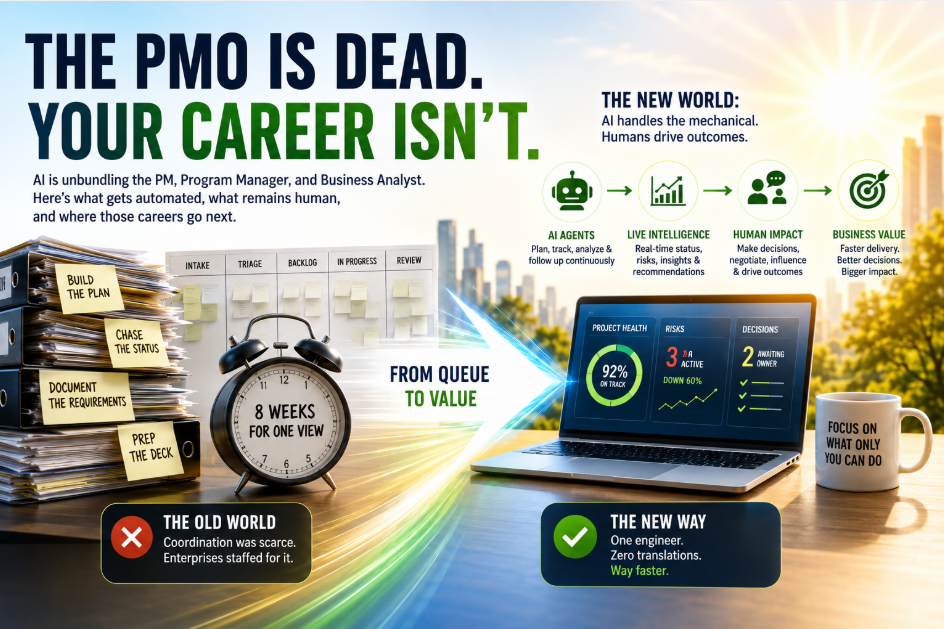
AI is unbundling the Project Manager, the Program Manager, and the Business Analyst. Here’s what gets automated, what remains human, and where those careers go next.
For three decades, the PMO ran on a simple bargain: coordination was scarce and expensive, so enterprises staffed for it. Someone had to build the schedule, chase the status, document the requirements, and prep the steering committee. That bargain is collapsing, not because the work stopped mattering, but because AI agents now do most of it continuously, at near-zero marginal cost.
The lazy version of this story is “AI kills the PMO.” The more useful question is the one almost nobody is asking: when a role compresses, where does the career go?
Start With a Number: The Role Compression Index
Role compression is the percentage of today’s human effort that can plausibly move to AI agents, automation, and agent-enabled platforms, not the percentage of business value the role provides. That distinction is everything. A role can compress 85% and become more valuable, because value was never evenly distributed across its tasks.
Here is the responsibility-level math, five responsibilities per role.
Project Manager: ~85% compressed
| Traditional responsibility | AI compression | What happens |
|---|---|---|
| Planning & scheduling | 95% | Agents build and re-plan schedules continuously from dependencies, capacity, and actual progress |
| Status collection & reporting | 95% | Live systems generate status, summaries, variance, and executive narratives |
| RAID management | 85% | Agents identify risks, dependencies, anomalies, and unresolved decisions continuously |
| Coordination & follow-up | 90% | Agents chase actions, schedule interactions, route work, and escalate exceptions |
| Stakeholder facilitation & escalation | 60% | AI prepares decisions; humans still negotiate, influence, and make judgment calls |
Program Manager: ~75% compressed
| Traditional responsibility | AI compression | What happens |
|---|---|---|
| Integrated roadmaps & dependencies | 85% | Agents continuously maintain dependency graphs and scenario impacts |
| Cross-project status & reporting | 95% | Automated from delivery, financial, and operational telemetry |
| Capacity & resource coordination | 80% | AI models people, agents, compute, and vendor capacity dynamically |
| Governance, risk & decision preparation | 75% | Agents identify exceptions and prepare decisions and recommendations |
| Executive alignment & trade-off decisions | 40% | Remains highly human: politics, negotiation, strategic judgment, accountability |
Business Analyst: ~90% compressed
| Traditional responsibility | AI compression | What happens |
|---|---|---|
| Requirements elicitation & documentation | 95% | Agents analyze meetings, processes, documents, systems, and existing behavior |
| Process discovery & mapping | 90% | Process mining and AI generate current-state and future-state workflows |
| Analysis & root-cause investigation | 90% | Agents query enterprise data, identify patterns, and test hypotheses |
| User stories, acceptance criteria & tests | 95% | Generated and continuously refined from intent and observed behavior |
| Stakeholder validation & interpretation | 80% | Much accelerates; humans remain essential for ambiguity and judgment |
The capacity math is blunt:
- One future PM absorbs the task load of 5 to 7 traditional PMs
- One future program manager absorbs 4
- One future BA absorbs 10
Those multiples don’t mean one person works ten times harder. They mean the mechanical work surrounding the role evaporates, and what remains is a different job entirely.
Isn’t the Human Just an Approval Button?
Here is the obvious objection, and it deserves a straight answer. If agents prepare the analysis, draft the decision, and queue it for sign-off, hasn’t the human contribution shrunk to a button click? And can’t the click itself be automated?
Mostly, yes. That is exactly the trap. Any role that reduces to approving what the agent already decided sits on the compressible side of the line, because rubber-stamp approval is the easiest task in the enterprise to automate away. The work that resists compression lives on either side of the button, not on it:
- Upstream: designing the decision architecture, meaning what the agent may decide autonomously, what requires review, what data and tools it can touch, and what thresholds trigger escalation
- Downstream: handling what the button can’t, including the recommendation that is technically correct but politically impossible, the novel case no evaluation covered, and the moment the numbers say proceed but judgment says stop
- Throughout: accountability, because when an approved action goes wrong, “the agent decided” will not survive contact with a CFO or a regulator
So the human role shifts from making routine decisions to owning the decision system: setting boundaries, catching exceptions, and answering for outcomes.
Roles Don’t Disappear. They Unbundle.
The low-value portions of each role collapse. The high-value portions migrate into new archetypes. The model looks like this:
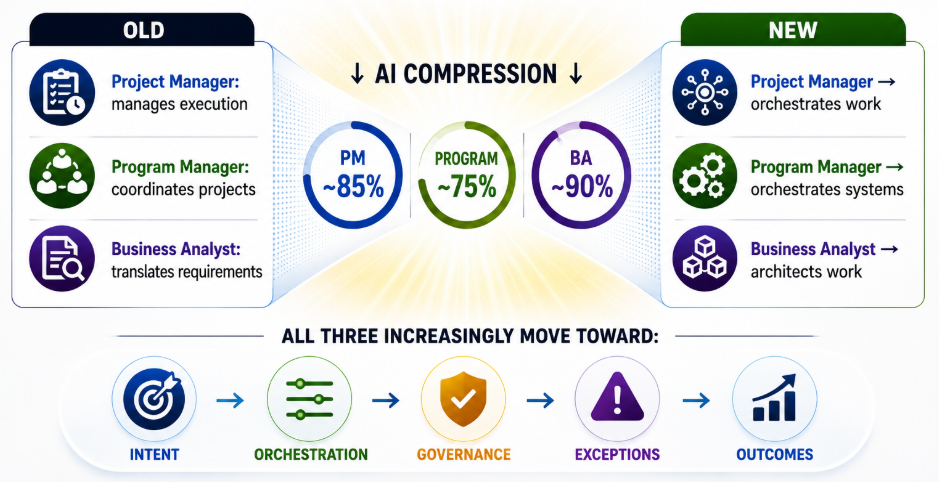
Map the migration in detail and nine destinations emerge.
Project Manager → three emerging paths
1. Delivery Strategist. Owns the front of the lifecycle: whether work is worth doing and what exactly it is. Frames the problem, scopes the initiative, decides the human-versus-agent split, builds the value case, and runs the commercial side: sourcing vendors, obtaining quotes, negotiating terms, and issuing purchase orders. Agents assemble the RFQs, compare the quotes, and generate the PO paperwork; the human selects the vendor, negotiates the deal, and is accountable for the commitment. Core skills: problem framing, discovery, scoping, solution shaping, value-case development, vendor sourcing and commercial negotiation, human-agent work design, stakeholder alignment.
2. Agent Delivery Orchestrator / Lead. Takes shaped work and lands it. Owns planning, estimating, and delivering initiatives through blended human-agent capacity: decomposing work, delegating to agents, designing the exceptions, and running many smaller initiatives concurrently instead of one monolithic project. This is where the five-to-seven-times capacity math becomes real. Core skills: planning and estimation, workflow decomposition, agent delegation, human-in-the-loop design, exception handling, orchestration, observability.
3. AI-Ops Lead. Owns the run side: the operational reliability of the AI-enabled enterprise, including the digital labor itself. Are agents executing correctly, safely, and economically, and are the platforms, pipelines, and automations beneath them healthy? Routine detection and remediation is agent work; the human commands the incidents no runbook anticipated and answers for production. Core skills: agent lifecycle management, AI evaluation, observability and telemetry, incident command, reliability engineering (SRE) practices, permissions and controls, AI cost and capacity management.
Read together, the three span the initiative lifecycle: one shapes and sources the work, one delivers it, one runs what it becomes.
Program Manager → three emerging paths
1. Enterprise Orchestration Lead. Designs how a business capability operates across functions, applications, data, agents, and human decision-makers. Core skills: systems thinking, enterprise architecture literacy, integration and API concepts, multi-agent orchestration, dependency modeling, process architecture.
2. AI Transformation & Value Lead. Moves beyond coordinating programs to driving the transformation itself: identifying where AI can materially change the operating model, prioritizing opportunities, sequencing investments, managing cross-functional dependencies, and holding the portfolio accountable for measurable value. Agents increasingly handle portfolio reporting, scenario modeling, dependency analysis, and benefit tracking; the human decides where to invest, what to stop, how aggressively to change, and whether the expected value is actually being realized. Core skills: transformation strategy, portfolio prioritization, value realization, investment governance, operating-model design, AI literacy, executive influence, dependency management, outcome measurement.
3. Product Ownership: Function, Department, or Value Stream. Owns the end-to-end technology-enabled capability rather than a collection of temporary projects. Core skills: product strategy, portfolio prioritization, business architecture, value-stream thinking, investment decisions, roadmap ownership, outcome measurement.
Business Analyst → three emerging paths
1. Agentic Business Architect. Designs how the business should operate when intelligent digital labor is available, rather than documenting how it works today. Core skills: business capability modeling, process decomposition, AI use-case discovery, business rules, semantic and data literacy, human-agent interaction design.
2. AI Workflow Architect. Redesigns processes as intent → agent → data → system action → exception → human. Core skills: process mining, workflow design, agent orchestration, integration literacy, exception engineering, human-in-the-loop patterns.
3. Organizational Change Lead: AI Adoption. Owns education, training, role redesign, champion networks, and adoption measurement, because this transformation is a way-of-working problem before it is a technology problem. Core skills: change management, AI literacy, communication, training design, workforce transformation, adoption analytics.
This isn’t speculative vocabulary. Salesforce is currently hiring an Agentforce Operations product manager and a Business Architect for Agentic Sales. ServiceNow is hiring AI Foundry Architects. The market is naming the destinations before most PMOs have acknowledged the departure.
The Skill Inversion
Underneath the migration sits a stark repricing.
- Declining in relative value: status reporting, documentation, scheduling, meeting coordination, requirements writing, manual analysis, action tracking
- Rising in value: problem framing, systems thinking, workflow decomposition, agent orchestration, AI evaluation, exception design, governance, outcome economics, judgment, influence
So sharpen the thesis:
- Project management disappears as a full-time bundle of administrative activity
- Business analysis stops being synonymous with documenting requirements
- Program management moves from coordinating projects to orchestrating systems of human and digital labor
The people who built careers coordinating information, projects, and requirements now face a genuine choice. Compete with AI for the shrinking middle, or expand in both directions:
- Upward into strategy: deciding what is worth doing and why
- Downward through execution: directing the agents that do the work, catching the exceptions, and owning the quantified business value that lands
The old career lived in the coordination layer between strategy and delivery. AI is hollowing that layer out. What survives is end-to-end ownership, from intent to measured outcome.
The PMO may be dying. The people inside it don’t have to die with it.