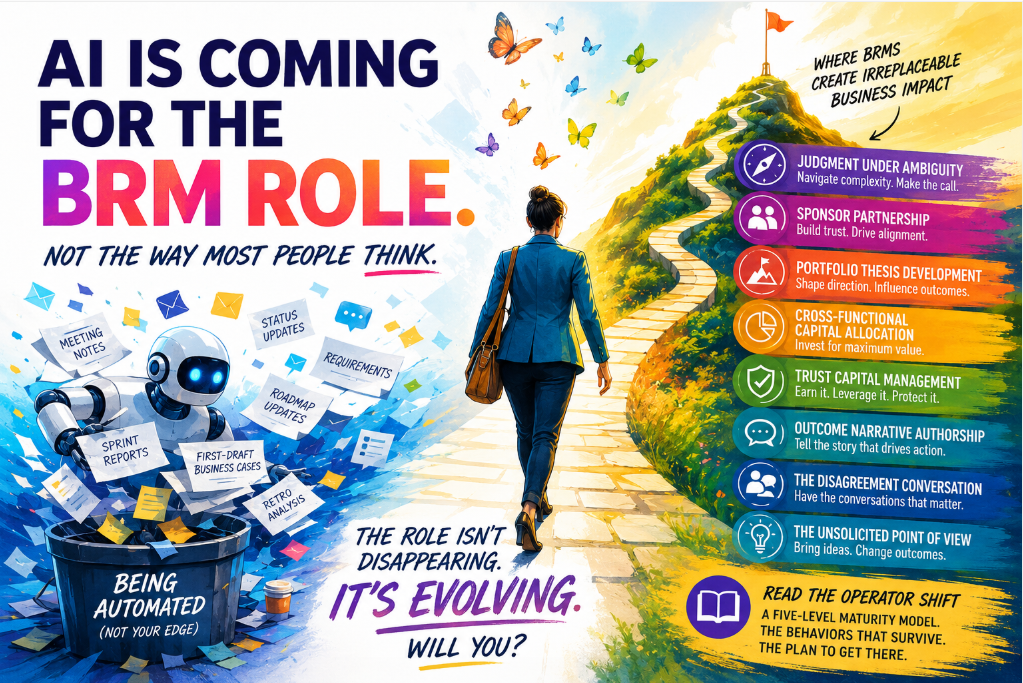
The story that AI will eliminate the role is wrong. The story that AI will leave it untouched is also wrong. The truth is more uncomfortable and more actionable: AI is going to compress the role into a smaller, more selective version of itself, and the practitioners who survive the compression are not the ones who learn the new tools.
Every article I read about AI and the BRM role makes one of two arguments. Either AI is going to eliminate the role within five years, or AI is going to leave the role mostly intact while making the work easier. Both arguments are wrong, and the reason they are wrong is the same. They treat AI as a tool that affects the role uniformly. It does not.
AI compresses the role asymmetrically. Some parts of the role are about to be absorbed almost completely. Other parts are about to become more valuable than they have ever been. The practitioners who survive the next three years are the ones who can tell which is which, and who shift their week accordingly before the compression catches them.
Here is the part of the role being absorbed. Translation. Requirements gathering and decomposition. Status synthesis. Stakeholder updates. Meeting notes. First-draft business cases. Sprint retro analysis. Routine roadmap maintenance. These are the activities that fill 40 to 60 percent of most BRM calendars, and they are also the activities that current and near-term AI tools already do at 70 to 80 percent of acceptable quality. Inside eighteen months, that figure will be higher. Inside thirty-six months, organizations will stop staffing these activities at the BRM level.
Here is the part of the role becoming scarcer and more valuable. Judgment under ambiguity. Sponsor partnership. Portfolio thesis development. Cross-functional capital allocation. Trust capital management. Outcome narrative authorship. The disagreement conversation in a one-on-one. The unsolicited point of view on a strategic question. These are activities AI cannot do, will not be able to do in the relevant time horizon, and that are currently underpriced because the volume of translation work has been crowding them out.
The compression is the gap between these two lists. The role is not going away. The role is getting narrower and more demanding. The same job title, in three years, will involve less of what most BRMs do today and more of what only the top quartile does today.
This is the part most career advice misses. The skill stack you need for the post-compression role is not a new skill stack. It is the existing senior skill stack, made mandatory at every level of the role. The behaviors that distinguished senior BRMs from mid-career BRMs in 2020 are about to become entry-level requirements in 2027.
The implication is uncomfortable. If your week today is 60 percent translation work, you are not going to fail because AI took your job. You are going to fail because the people promoting into senior BRM roles in 2027 spent the last three years practicing the behaviors that AI cannot do, and you spent the last three years practicing the behaviors that AI can.
The question that matters now is not which AI tools to learn. The question is which behaviors to start practicing before the compression makes them table stakes. The behaviors are knowable. They have been knowable for years. They are the behaviors that have always separated practitioners at the top of the role from practitioners in the middle of the role. The difference is that the middle of the role is about to disappear, and the practitioners currently sitting in it will either move up or out.
I have been mapping these behaviors against a five-level maturity model for several years now. The model existed before AI compression became visible as a force, and the model has not needed to change much in response to it. What AI is doing is collapsing the distance between the levels. The lower levels are being absorbed. The upper levels are becoming where the role lives.
The Operator Shift supplement lays out the model in full. The five levels, the specific behaviors at each level, the transition plan from one level to the next, and the diagnostic for figuring out where you currently operate. It is not an AI book. It happens to be the book that matters most if you are trying to survive what AI is about to do to the role.
The compression is already underway. The behaviors that survive it are the ones to start practicing now.