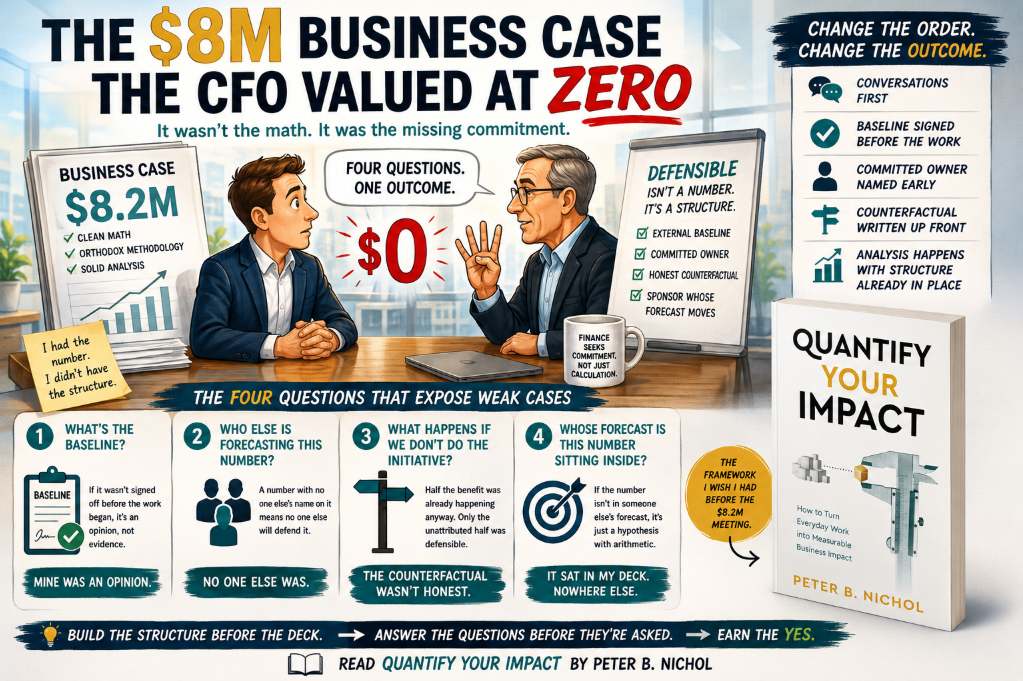
My math was clean. My methodology was orthodox. The number on the cover page was $8.2M. By the end of a four-question conversation with the CFO, the defensible value had been adjusted to zero.
I built a business case for an $8.2M initiative. Eight months of work. Clean math. Orthodox methodology. I walked into the finance review confident the funding was already decided. The CFO listened, asked four questions, and by the end of the conversation the defensible value of my case had been adjusted to zero.
That meeting reorganized how I think about quantification. Not because the math was wrong. Because I had built a case for a number, when what finance needed was a case for a commitment.
Here is what the four questions exposed.
The first question was about the baseline. I had a baseline. I didn’t have one anyone had signed off on before the work began. The CFO’s position was simple. If the baseline arrives with the case, it is an opinion. If it pre-dates the work, it is evidence. My baseline was an opinion.
The second question was about who else was forecasting the number. I had built the case in isolation, which felt like a virtue at the time. Independent analysis. Defensible methodology. The CFO didn’t see independence. The CFO saw a number with no one else’s name attached, which meant no one else was going to defend it if the work missed.
The third question was about the counterfactual. What was going to happen if we didn’t do the initiative? I had a paragraph on this. The paragraph was descriptive, not committed. The CFO’s read was that absent the work, half the benefit was going to materialize through other forces already in flight. The half that wasn’t was the only defensible portion of my number.
The fourth question was the one I didn’t have an answer for. “Whose forecast is this number sitting inside?” I had built the case. I had not built the commitment. The number lived in my slide deck and nowhere else. From the CFO’s perspective, a number that no one had committed to their own scorecard was a hypothesis with arithmetic.
I left the meeting with a different understanding of what “defensible” actually means. Defensible isn’t a property of math. It is a property of the case structure that surrounds the math. A defensible case has an external baseline. A defensible case has a committed owner. A defensible case has an honest counterfactual. A defensible case has a sponsor whose forecast moves because of it.
The four questions also became a diagnostic I now run on any business case I touch, mine or someone else’s, before the deck is built and sometimes before the work has started. If I cannot answer the four questions cleanly, the case is not ready, regardless of how strong the math is going to be. The four questions are not the CFO’s job to ask. They are my job to answer before the CFO has to.
What changed in my practice after that meeting was the order of operations. Before the $8.2M case, I did the analysis first and the conversations second. The conversations were socialization. They were where I tested whether my number landed. After the meeting, I reversed the order. The conversations come first. The baseline gets signed before the work begins. The committed owner gets named before the analysis is finished. The counterfactual gets written before the solution is proposed. By the time the analysis happens, the structural risks have already been removed.
This is the moment I started building what I now call the Quantified Impact Framework. The framework wasn’t designed in a classroom. It was built backward from the questions that killed cases I had spent months on. Every field in the 7-field schema exists because some version of that meeting had taken place — mine, or someone else’s I had watched.
The system is in the book. The schema, the three value lanes, the intake discipline, the counterfactual practice. None of it is complicated. All of it is the kind of work that has to be done before the case is presented, not after.
Quantify Your Impact is what I wish I had read before the $8.2M meeting. The book will not prevent every adjustment in a finance review. It will make sure the questions don’t catch you the way they caught me.