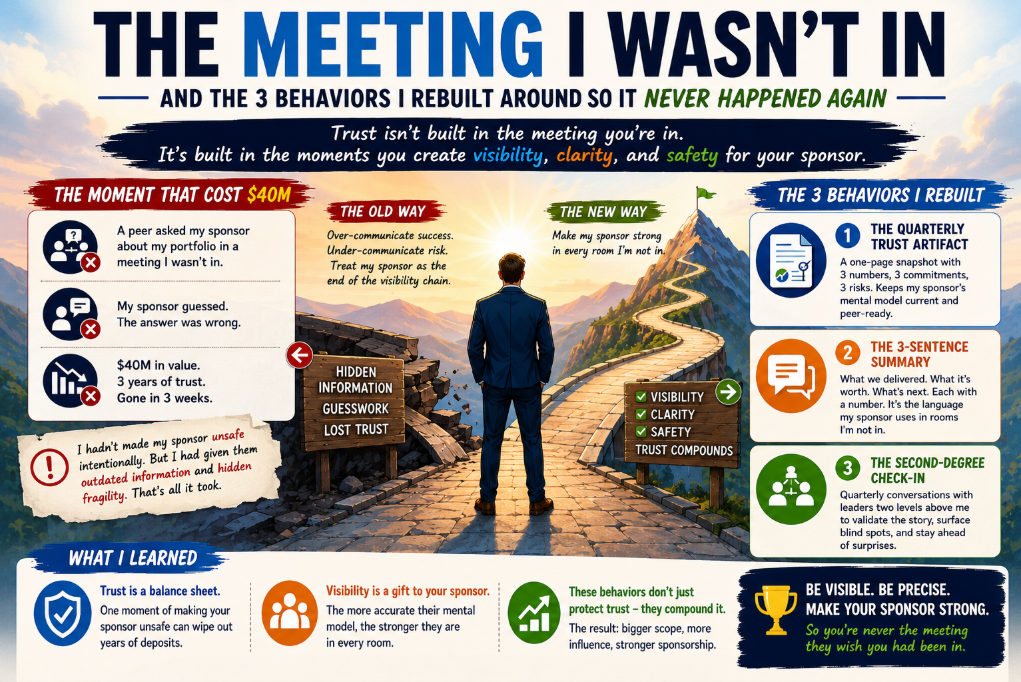
A $40M sponsor relationship dissolved not because of a missed deadline, but because I’d built trust the wrong way. Here’s what I rebuilt.
The losing moment wasn’t a missed deadline.
It wasn’t a bad business case. It wasn’t a quarterly review gone wrong. It wasn’t anything I would have flagged at the time as a trust event. It was a meeting I didn’t ask to be included in, where my sponsor was asked a question about my portfolio and had to guess at the answer. The guess was wrong. Three weeks later I had a new sponsor and a much smaller scope of work.
The portfolio was worth approximately $40M in tracked annual value across roughly thirty initiatives. The relationship had taken three years to build. It dissolved in the span of one off-the-record conversation in a room I wasn’t in, and I didn’t see it coming because I had been measuring my trust the wrong way.
This post walks through what happened, what I’d been doing wrong, and the three behaviors I rebuilt around in the eighteen months that followed. Two of the three are unglamorous. None of them involve working harder. All of them have held up across two subsequent sponsor transitions.
What happened
The meeting was a peer-level executive review. My sponsor was asked by a counterpart whether my portfolio could absorb a new program that had landed mid-quarter. My sponsor said yes, citing capacity and momentum he believed we had. The capacity wasn’t there. We’d been quietly stretched for two months. The momentum he cited was attached to a specific initiative that was in a more fragile state than my reports had described.
The counterpart took the answer back to their team. A program was promised based on that capacity. Three weeks later, when the actual state of the portfolio became visible, the promise had to be walked back. My sponsor lost face with the counterpart. The counterpart escalated. By the time the dust settled, my portfolio had been rescoped to a fraction of its previous size and a different sponsor had been assigned to oversee what remained.
What I’d done wrong wasn’t in the meeting I missed. It was in the eight months before the meeting. I’d been over-communicating successes, under-communicating fragility, and treating my sponsor as the end of the visibility chain rather than the start of it. By the time the question came up, my sponsor’s mental model of my portfolio was outdated and overconfident. He answered the question based on that model — not because he was careless, but because I’d never given him the inputs to know the model was stale.
The trust withdrawal wasn’t the inaccuracy. It was the fact that I’d made my sponsor unsafe in front of his peer. That’s an unrecoverable withdrawal in the executive trust balance sheet. It doesn’t matter that I’d been delivering for three years. The single moment where my sponsor was made unsafe canceled the running balance.
The three behaviors I rebuilt around
I spent the next eighteen months rebuilding around three behaviors. Each one addresses a specific failure mode from the lost portfolio. Each one has stayed in place through two subsequent sponsor transitions and is now the default operating pattern I run.
Behavior 1: The quarterly trust artifact
Once a quarter, I produce a one-page document I call the trust artifact. It has three sections: three numbers, three commitments, three risks. Each section is two to four sentences. The whole document fits on one page.
The three numbers describe the current state of the portfolio at a level my sponsor’s peer could absorb in thirty seconds. Run-rate value tracked, initiatives active, sustained outcomes captured year-to-date. The numbers are anchored to the 7-field schema and pre-defended.
The three commitments describe what the portfolio will deliver in the next quarter, with named owners. Not aspirational — committed. If the sponsor can’t repeat the commitment in their own words to a peer, it doesn’t go in.
The three risks describe what could go wrong, with the current mitigation in place. The risks section is the part I previously skipped. It’s the section that prevents the unsafe moment I created in the lost portfolio.
The artifact takes thirty minutes to produce after the first one. The first one took two hours. My sponsor reads it before quarterly executive reviews. They’ve never gone into a peer conversation about my portfolio with an outdated model since I started producing it.
Behavior 2: The three-sentence summary
I never let a written communication about my portfolio leave my desk without a three-sentence summary at the top.
The three sentences are: what we delivered, what it’s worth, what’s next. Each sentence has a number in it. The summary is the part the sponsor reads. The detail underneath is the part the analyst reads. The discipline is that the summary has to stand alone. If the rest of the document gets cut, the three sentences should still describe the portfolio accurately.
This sounds like clerical work. It isn’t. The three sentences are the language my sponsor uses to describe my portfolio to their peers. If I don’t write the sentences, my sponsor writes them — and the version they write is the version that travels in the rooms I’m not in. The lost portfolio was a case where my sponsor wrote the sentences and the version that traveled was wrong.
The three-sentence summary is the simplest move in this entire framework. It’s also the most underused. Most BRMs I work with adopt it within a week and tell me later it was the single change with the largest visible effect.
Behavior 3: The second-degree check-in
Once a quarter, I have a conversation with someone two levels above me whose visibility into my portfolio I want to verify.
These conversations are scheduled, never ambushed. They’re framed as “I want to make sure your model of what my team is working on is accurate,” not as “let me sell you on what we’ve been doing.” The framing matters. The goal is to find out where the second-degree mental model has drifted from reality, not to perform.
I learned within the first two conversations that the second-degree model drifts faster than I’d assumed. Eighteen months after I started the cadence, I’d had four conversations where the skip-level executive had a meaningfully different understanding of my portfolio than my sponsor did. None of the drift was hostile. It was just compounding miscommunication, the kind that builds quietly across two sponsor layers without any single conversation looking wrong.
The check-in closes the visibility gap before it becomes a meeting I’m not in. The lost portfolio was a case where the gap had compounded for months and the sponsor’s answer was based on assumptions the skip-level had inherited from earlier, incorrect framing. The check-in surfaces that drift while it’s still recoverable.
What I no longer do
The three behaviors above are the additions. They sit alongside three subtractions — three habits I had to unlearn after the lost portfolio.
I no longer over-communicate successes without paired risks. The portfolio was running fine. My sponsor had been told it was running fine. The fragility that was underneath didn’t surface because I’d treated it as private operational detail, not as something my sponsor needed to know. The rebuild rule: every success communication includes a risk communication. Same document, if possible.
I no longer treat my sponsor as the end of the trust chain. They’re the start. Everything I communicate is built to be passed forward: language, numbers, sentences, summaries. The audience isn’t the sponsor. It’s the people the sponsor talks to.
I no longer assume capacity is visible. Capacity is the most invisible state in a BRM portfolio. Two months of stretch isn’t visible to a sponsor unless you make it visible. The quarterly trust artifact has a section on capacity now, because the lost portfolio was, at root, a capacity miscommunication.
What this took
The three behaviors took about four hours per quarter to install and now take about two hours per quarter to maintain. That’s the entire cost.
The eighteen-month rebuild was the cost of not having had them in place earlier. The portfolio I lost was real. The relationship took three years to build and twenty minutes to lose, and the loss was not visible to me until it had already happened. The cost was career-shaped, not work-shaped.
If you’re reading this and your portfolio looks healthy, run the second-degree check-in this quarter. Find out if the skip-level model of what you’re doing matches what you’re actually doing. If it doesn’t, you have the same problem I had. You just don’t know it yet.
The full trust artifact cadence, the second-degree visibility play, and the rebuild sequence I ran in the eighteen months after the lost portfolio are in Earn Strategic Trust.