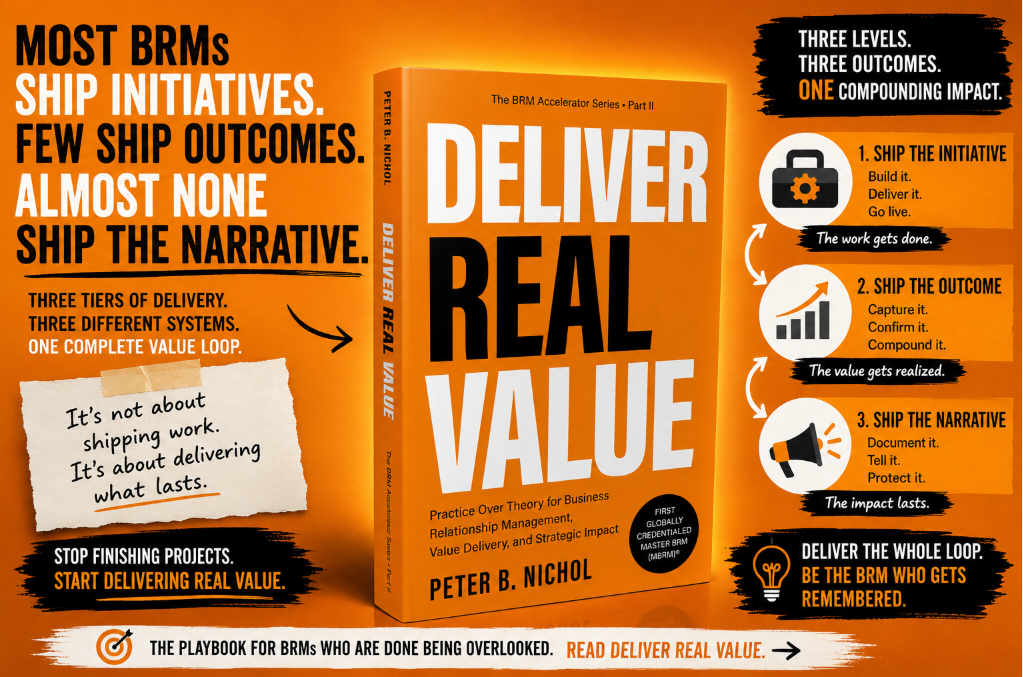
Three tiers of delivery, three different operating systems. Most practitioners spend their entire careers in tier one and don’t know the other two exist as distinct disciplines.
There are three tiers of delivery in any IT organization. Most BRMs operate in the first tier and do not know the other two exist as distinct disciplines.
Tier one is shipping the initiative. The team builds what was asked, hits the milestones, navigates the technical risks, manages the dependencies, and goes live on time and on budget. This is the tier the role description was written for. It is the tier that performance reviews evaluate. It is the tier where most BRMs spend their entire careers, and it is the only tier the broader organization has language for.
Tier two is shipping the outcome. This is what happens after go-live. The run-rate is captured. The savings show up on someone’s scorecard. The hours redirected get re-allocated to higher-value work. The vendor consolidation actually closes. The revenue lift compounds. Tier two requires a different operating system than tier one, because the team that built the initiative is not the team that captures the outcome. Tier two requires a measurement cadence, a named owner, and a finance partner who confirms the numbers quarterly. Most programs never staff tier two and quietly evaporate.
Tier three is shipping the narrative. This is the tier almost no one operates in deliberately. The narrative is what your sponsor says about the program eighteen months after launch, in a meeting where you are not present, when an executive asks about the work. If the narrative has been written, your sponsor has language to use. If it has not, your sponsor improvises, and improvised narratives accumulate errors over time until the program is described in terms that have only loose connection to what was actually delivered.
The narrative is the highest-leverage artifact in the entire value delivery loop. It costs about four hours per quarter to maintain. It buys eighteen to thirty-six months of accurate organizational memory about a program that would otherwise drift. I have never seen anyone calculate the return on this artifact and decide it was not worth doing. Most BRMs do not write it because nobody put it on the calendar.
The three tiers are sequential and compounding. Tier one without tier two is a finished project with no demonstrable value capture. Tier two without tier three is a captured outcome that fades from organizational memory within two years. Tier three without tier one is a story about work that did not actually happen, which is its own problem and worth a separate post.
The reason almost no one ships the narrative is that the role description does not ask for it. It is not on a project plan. It is not tracked by a PMO. It does not have a milestone gate. The narrative is voluntary work that has to be done by someone who has chosen to operate at a higher tier than the role description requires.
That someone, when it exists, is usually the BRM who has decided to run their portfolio as a business rather than as a request queue. The narrative is the artifact that makes the portfolio legible to the rest of the organization. It is the artifact that survives reorganizations, sponsor transitions, and leadership churn. It is the artifact that compounds across years.
Deliver Real Value is the book that lays out the three-tier model in full. The value delivery loop, the measurement scaffolding, the narrative cadence, and the artifacts required at each tier. The book is built for BRMs who have mastered tier one and are ready to operate at tier two and tier three deliberately.
If you have been shipping initiatives cleanly for five years and still cannot answer the question “what did the work actually produce?” the book is for you. The work is real. The narrative is the missing artifact.